Why SaaS Product Design Fails When You Separate Design from DevOps Domain Knowledge
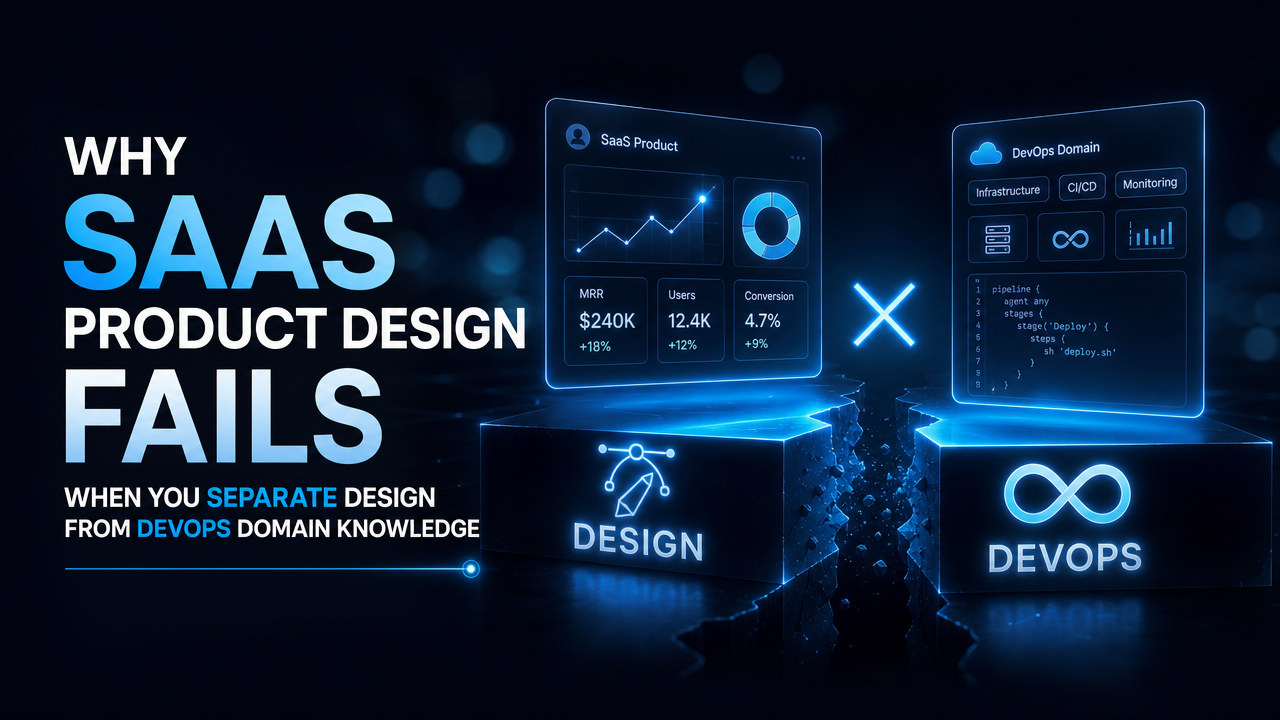
The Silent Killer in SaaS Product Design: Design Without Context
A fully polished product interface means nothing if it solves the wrong problem for the wrong workflow. This is the blind spot in most SaaS product design: agencies that excel at conversion funnels and dashboard layouts but have never shipped a DevOps tool, built an infrastructure platform, or sat inside an on-call incident response loop.
When you design a SaaS product without deep domain knowledge of how your users actually work, you optimise for aesthetics and guessed-at user journeys—not for the real, messy decisions your customers make under pressure. In DevOps, infrastructure, and incident management tools, this gap is fatal. A beautifully designed alert panel that ignores how engineers triage during an outage isn't a product that sells itself. It's a product that loses adoption the moment your early adopters hit production.
The DevOps Design Blindspot
Most SaaS design agencies have never worked inside the tools they design for. They don't know the difference between a workflow designed for a security engineer reviewing policies at 9 AM and one designed for an on-call SRE at 3 AM handling a P1 incident. They don't understand role-based visibility constraints, API-first architectures, or why a developer won't tolerate a three-click flow to check system status.
This isn't a small UX detail. In infrastructure and DevOps products, design decisions directly affect operational reliability and team friction. A modal that feels elegant in Figma becomes a liability when your users need to make a decision in 15 seconds. A navigation pattern that works for B2B SaaS marketing tools creates cognitive overhead in a tool where time-to-information is measured in seconds.
The Small Square's foundation is different. Our lead designer spent over a decade inside Mattermost, the open-source DevOps collaboration platform, where every design decision was tested against real incident workflows, playbook automation, and team synchronisation patterns under stress. That wasn't just design work—it was domain knowledge earned through shipping. Before that, we designed and shipped Focalboard, an open-source project management tool that required understanding how teams actually structure work across technical and non-technical roles.
That background changes everything about how we approach a new DevOps or infrastructure product.
What Domain-Aware Design Actually Looks Like
Domain expertise in product design shows up in three concrete ways:
1. You Know What Users Don't Say They Need
A founder building a DevOps monitoring tool will tell a designer, "Engineers need to see system status." A designer without DevOps context will design a dashboard. A designer who has built inside a DevOps platform knows engineers also need:
- Single-screen visibility into dependent services (not a cascading menu)
- Keyboard shortcuts for power users (not just mouse-driven flows)
- Audit trails and role-based filters for security and compliance teams
- Mobile-safe workflows for on-call scenarios where a laptop isn't available
- Integration patterns that fit into existing CI/CD pipelines and runbooks
None of these emerge from generic SaaS design best practices. They emerge from having worked in that space.
2. You Design for Multiple Personas Simultaneously
A DevOps platform isn't built for one user type. An incident management tool serves on-call engineers, team leads reviewing post-mortems, security officers auditing playbooks, and executives tracking MTTR. A design that optimises for one persona breaks for the others. Domain expertise means understanding the hierarchy of needs across those roles and designing interfaces that don't require switching contexts.
Mattermost taught us this at scale. The platform had to work for DevOps engineers managing playbooks, security teams enforcing compliance, incident commanders coordinating responses, and executives reviewing metrics. A single interface that fails any of those personas is a product that loses adoption in one department, even if it's perfect for another.
3. You Avoid the Design-Engineering Friction That Kills Adoption
Generic SaaS design often produces beautiful mockups that are expensive or impossible to build at the required performance level. A cloud infrastructure dashboard can't have unnecessary re-renders. A monitoring tool can't buffer updates through a state management layer that adds 200ms latency. An incident management interface needs optimistic UI updates to feel responsive during high-stress scenarios.
When a designer has shipped in that space before, they know the engineering constraints before the design review. The interface is built to be feasible, performant, and deployable—not beautiful in a way that makes engineers wince at the implementation cost.
Why This Matters for Your Funding and Growth
Early-stage founders often assume design is a polish problem. It isn't. Design is a product-market fit problem, and domain knowledge is the differentiator that tips that fit into your favour.
When you raise Series A, investors will ask: do your users choose you because you're easy to use, or do they choose you because you solve a problem they have no other way to solve? If the answer is only "it's easy to use," you're one design competitor away from obsolescence. If the answer is "we understand their workflow better than anyone else," design becomes your moat.
That moat comes from a designer who has shipped in that domain, made mistakes at scale, and built the intuition to avoid them in your product.
How to Know If Your Designer Has Real Domain Knowledge
Ask them:
- Have you shipped a product in this space? Not designed one. Shipped one, watched it fail, iterated it, and seen it adopted. (Portfolio case studies should show depth: multiple releases, feature evolution, and real user feedback incorporated.)
- Can you articulate the workflows your users are in right now? Without prompting. Not the workflows they'll be in, but the ones they're in today. What's their current tool? What do they hate about it? Why?
- Do they ask about engineering constraints before the design phase? A designer who knows your domain will want to understand your architecture, your API patterns, and your scalability challenges. They'll treat these as design constraints, not afterthoughts.
- Can they walk through a role-based interface without confusing the personas? Pull up a dashboard. Ask them to use it as an on-call engineer, then as a security officer, then as a team lead. Can they articulate how the interface serves all three?
If your designer can't answer these questions with specificity, they're designing based on SaaS best practices, not domain expertise. That's fine for certain product categories. It's a liability in DevOps, infrastructure, security, and any tool where users have deep, evolved workflows and high switching costs.
The Real Cost of Generic SaaS Design
When you hire a generalist SaaS agency, you're betting that their conversion-focused design principles and dashboard layout patterns will translate to your space. Sometimes they do. More often, you ship a product that looks and feels professional but doesn't convert because it doesn't fit how your users actually work.
The Small Square's approach is the inverse. We design products around the workflows and constraints of the space first, then apply the design rigour that makes those workflows intuitive and conversion-focused. For DevOps and infrastructure tools, that domain knowledge isn't a nice-to-have. It's the core competency that separates a product that gets adopted and a product that gets evaluated and abandoned.
If you're building a tool in a domain where the designer's background matters—DevOps, incident management, infrastructure, security, or any workflow-heavy SaaS category—your design partner should have shipped in that space. That's not a credential to check off. It's the foundation of a product that users choose because it fits how they work, not because it looks good in a screenshot.
The Small Square specialises in product design for early-stage SaaS founders in technical domains. If your product requires deep domain knowledge to design well, a free strategy call can help clarify whether your current design approach matches the complexity of your space.



Accepted Payments

