Framer vs Webflow vs Custom Code: What Smart Agencies Recommend in 2026
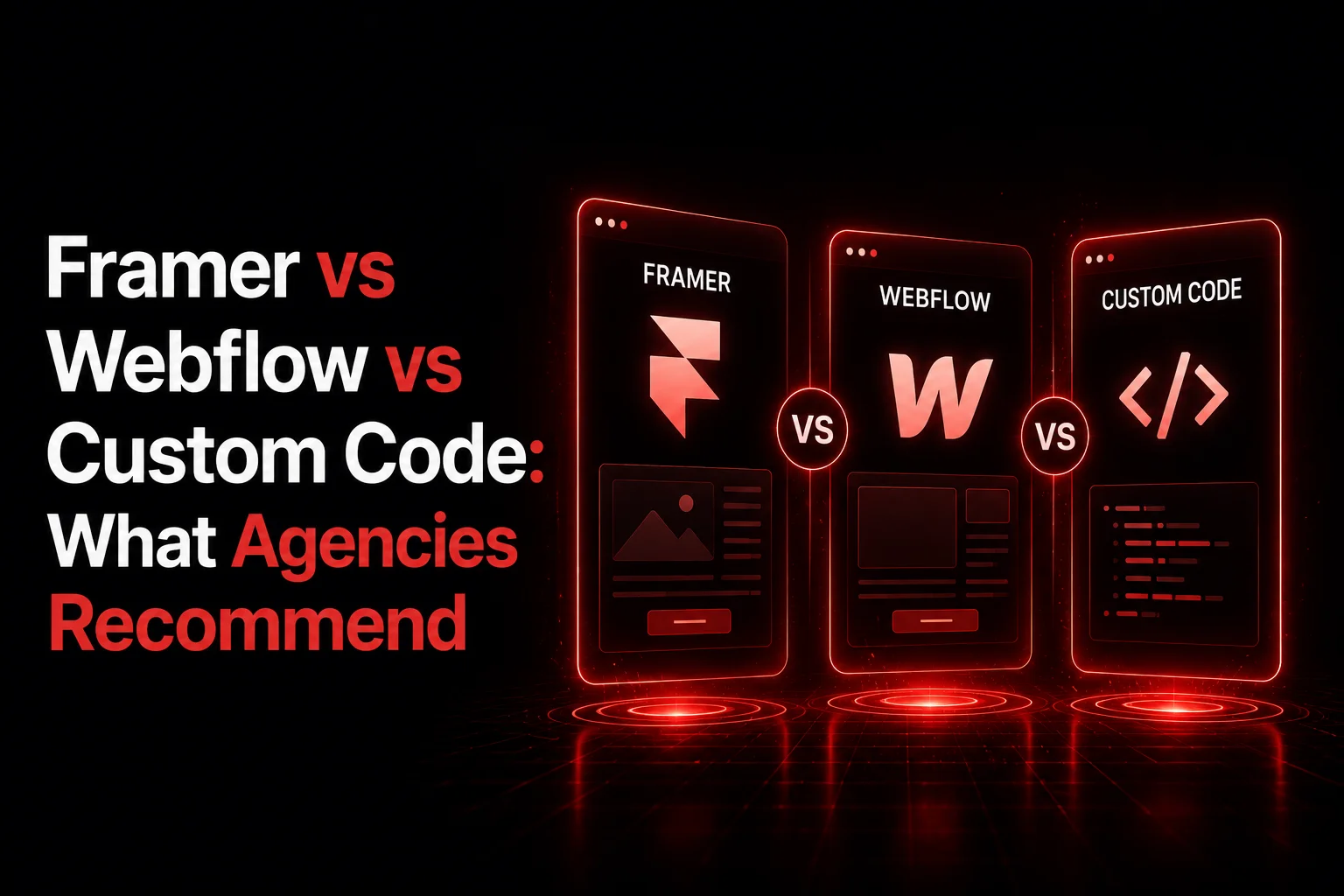
The three options have never been more different from each other. Framer shipped a completely redesigned CMS in late 2025. Webflow crossed 4 million published sites. Custom development frameworks matured significantly. The right answer in 2026 depends on a specific set of conditions, and getting it wrong still costs businesses three to six months and $30,000 to $80,000 in rebuilds.
4M+
Sites built on Webflow in 2026
3 wks
Avg. Framer site launch timeline
$60K
Avg. cost of a wrong platform rebuild
Most platform decisions are made wrong, and for the same reason: the choice is based on what looks good in a demo or what the agency is most comfortable building, rather than what the business will actually need in 12 to 18 months.
The result is predictable. A site gets built on the wrong foundation. The product grows. The platform cannot keep up. The rebuild starts. Time and budget that should have gone into growth go into fixing a decision that could have been made correctly from the start.
This article is a practical breakdown of all three options, where each one is genuinely strong, where each one breaks, and how to make the decision before it becomes expensive to change.
The three questions that determine the right platform
Every platform decision should start with three questions. Not with aesthetics, not with trends, and not with what the agency prefers to build.
Question 1: What does the site need to do in 12 months?
Marketing only? App-like features? User authentication?
Question 2: How fast does it need to ship?
3 weeks? 3 months? Ongoing iteration after launch?
Question 3: Who will maintain it after launch?
The founder? A designer? A dedicated dev team?
// These three questions determine the platform.
// Everything else is a secondary consideration.
An agency that recommends Webflow for every project is optimizing for its own workflow. Same with one that always pushes custom code. A platform recommendation that does not start with these questions is not a recommendation. It is a default.
THE REBUILD PROBLEM
The most expensive platform mistake is not choosing the wrong tool. It is choosing a tool without accounting for where the product is going. A Webflow site that works perfectly at launch can become a $70,000 rebuild problem 14 months later if the product roadmap required features the platform cannot support.
Framer in 2026: genuinely strong, with a clear ceiling
Framer in 2026 is a meaningfully different product from two years ago. The CMS overhaul in late 2025 made it a serious content platform, not just a prototyping and design tool. The Vercel edge deployment is fast. The React output is clean enough that developers can extend it without rewriting everything.
But the ceiling is real, and sites consistently hit it at the same point.
WHERE FRAMER IS THE RIGHT CHOICE
SaaS marketing sites and landing pages
Framer consistently scores 90 to 98 on PageSpeed with minimal configuration effort. For any product where the marketing site needs to feel premium and load instantly, Framer is the fastest path to that result.
Design-led brands with frequent iteration
Businesses that want to update messaging, test new headlines, or run landing page experiments every few weeks benefit significantly from Framer's visual editor.
Pre-product startups validating positioning
Framer allows complete redesigns in an afternoon, making it ideal during early validation stages.
WHERE FRAMER BREAKS DOWN
Content-heavy sites
Framer struggles with relational CMS structures, multi-author workflows, and large-scale content operations.
Membership or gated content
No native membership layer. Workarounds are fragile.
Complex e-commerce
Only supports basic storefronts and Stripe checkout.
THE HONEST FRAMER VERDICT
Use it for marketing sites, landing pages, and early-stage startup websites where speed and visual quality matter most. Avoid it when CMS scale, membership, or complex integrations are required.
Webflow in 2026: the strongest middle ground, with caveats
Webflow crossing 4 million published sites reflects its position as a balanced platform for business websites. It combines flexibility, performance, and maintainability at scale.
WHERE WEBFLOW IS THE RIGHT CHOICE
SaaS content marketing
Blogs, case studies, documentation—all managed without developers.
Service businesses and agencies
Non-technical teams can manage content independently.
Post-PMF SaaS brands
Enterprise-grade marketing sites with scalable CMS.
WHERE WEBFLOW BREAKS DOWN
Heavy animations
Poor performance often caused by poor implementation, not the platform.
Backend logic
No real backend capabilities for product-level functionality.
Plugin dependency risk
Third-party tools introduce fragility.
PERFORMANCE KILLERS FOUND ON WEBFLOW AUDITS
- Lottie animations on page open
- Font @import instead of preload
- Uncompressed PNG hero images
- Third-party chat widget in head
- Unused interactions left active
Custom code in 2026: when it is the only honest answer
Custom development is often overused or underused. The real threshold is clarity of requirements and engineering capacity.
WHEN CUSTOM CODE IS THE RIGHT ANSWER
SaaS product interfaces
Authentication, APIs, real-time data, dashboards.
Regulated industries
Fintech, healthcare, legal systems.
Large-scale applications
100,000+ active users and beyond.
WHEN CUSTOM CODE IS WRONG
If no team exists to maintain it, it becomes technical debt.
Marketing sites rarely need custom code early-stage.
The decision framework
1. What does the site need in 12 months?
Plan for future requirements, not current needs.
2. Who will maintain it?
Match platform to actual operators.
3. What is the timeline?
Speed may override architecture.
4. What is the product roadmap?
Future features should influence present choice.
How to evaluate an agency’s recommendation
GOOD SIGNS
- They ask about roadmap first
- They don’t default to one platform
- They separate product vs marketing site
- They explain maintenance clearly
WARNING SIGNS
- Platform chosen too early
- One-tool-only agencies
- No migration or scaling strategy
We take two clients at a time.
Not because of capacity. Because the wrong platform decision costs $30,000 to $80,000 to reverse.
Conclusion
Choosing between Framer, Webflow, and Custom Code is not a design decision—it’s a long-term business decision. Framer works best when speed, design quality, and rapid iteration are the priority. Webflow is the strongest all-round option for scalable marketing sites with structured content and non-technical teams.
Custom code becomes necessary only when the product demands advanced functionality, real-time systems, or deep backend logic that no visual builder can support. The real mistake most businesses make is not the platform itself, but failing to think ahead about where the product will be in the next 12 to 18 months. A well-timed, well-matched decision today prevents costly rebuilds, wasted time, and lost momentum tomorrow.
At The Small Square, we help businesses evaluate their growth plans, technical requirements, and marketing goals before recommending a platform. Whether you're considering Framer, Webflow, or a fully custom solution, choosing the right foundation from the start can save significant time, budget, and resources as your business scales.



Accepted Payments


