Why SaaS Founders Hire Design Agencies Instead of AI Tools (And When They're Right)
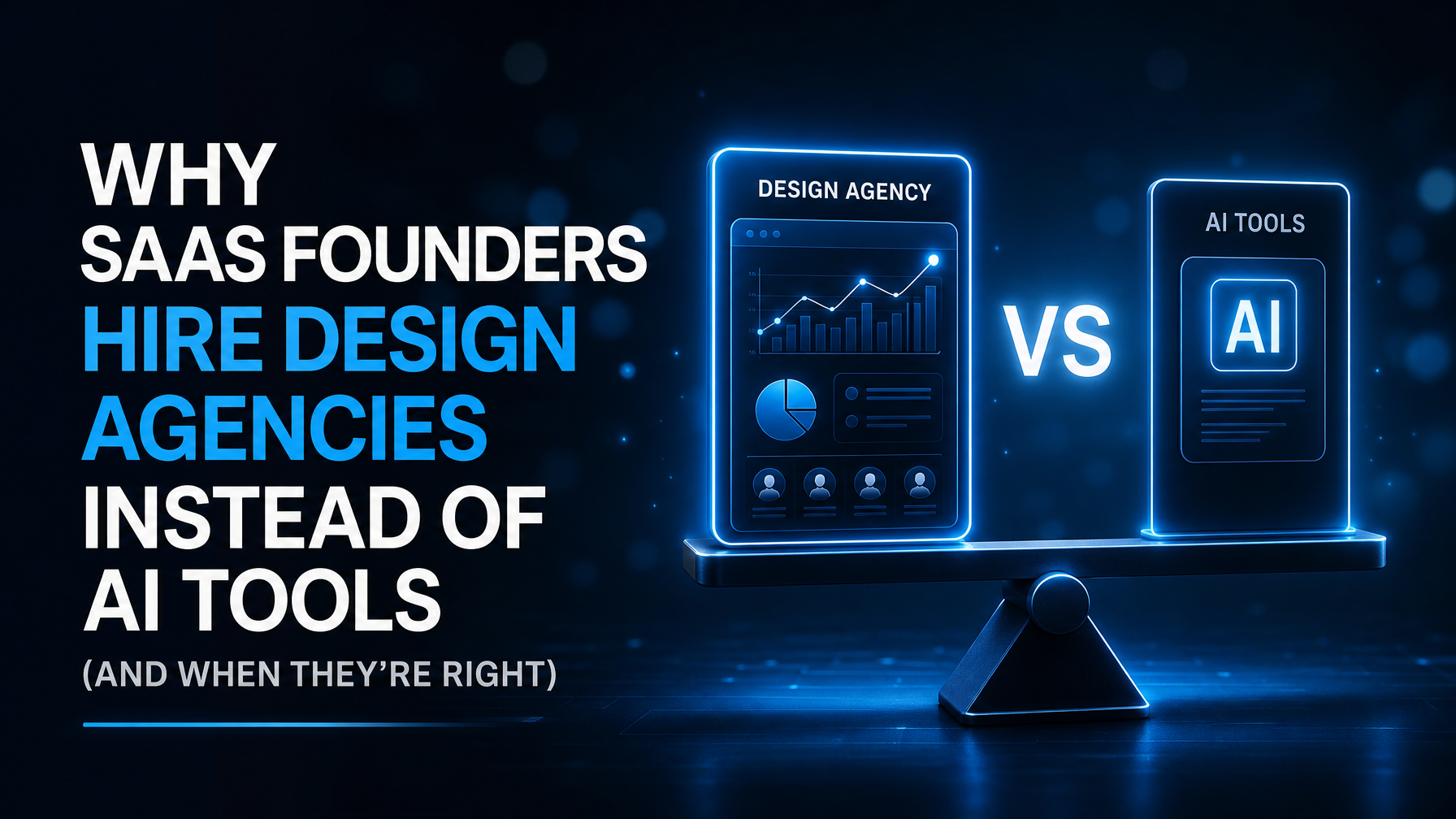
The Temptation Is Real
You have a product idea, a technical co-founder, and $50K to spend before launch. You've seen Claude build interfaces in seconds. You've watched Lovable scaffold a functional prototype. You know about v0. So you ask yourself: why pay a design agency $20K, $40K, or more when AI can generate a competent UI overnight?
This question is exactly right. And the answer isn't always "hire an agency." But the founders who actually do hire one—and who report shipping products that attract paying customers without burning cash on customer acquisition—are solving a different problem than the ones who think they're choosing between tools.
What AI Design Tools Actually Do (And Don't)
AI design tools are velocity plays. They're excellent at generating layouts, component variations, and functional prototypes in real time. A tool like v0 or Lovable can turn a written spec into a clickable interface in minutes. If you need to validate a workflow quickly, or iterate on copy and spacing without a 48-hour design review cycle, these tools compress time dramatically.
What they don't do is strategy. They don't ask "Who buys this? What action do they take first? Why would they stay instead of leaving?" They don't audit your conversion funnel and tell you that your pricing page asks five questions when it should ask one. They don't know that SaaS buyers spend 8 seconds on a landing page before deciding if you're credible. They don't know your market, your competitors, or the psychological levers that make one dashboard feel in-control and another feel overwhelming.
AI tools optimize for correctness of the output given the input. Design strategy optimizes for business outcome given the market. Those are not the same thing.
The Real Cost of DIY Design
A bootstrapped SaaS founder built a dashboard UI with Lovable in a week. The interface was clean. The buttons worked. Users could log in, add data, run queries. But sign-ups plateaued at 40 per month—nowhere near the 200 he'd projected. He didn't know why.
A design audit revealed the problem: the dashboard buried the core value proposition two clicks deep. New users saw a blank canvas and had no sense of what the tool did. Onboarding copy was generic ("Welcome to Your Dashboard"). The call-to-action on the landing page didn't match the first action a user needed to take in the product. The pricing page had no answer to the most common objection: "Can I try this free first?"
Fixing those three things—restructuring the information hierarchy, rewriting onboarding flows, redesigning the landing page with a clear trial offer—took four weeks of professional design work. The founder could have hired a design agency for that work at the outset for the same 28-30 days of calendar time, but compressed into two weeks and locked in before launch.
The cost of starting with an AI-generated UI wasn't the time spent building it. It was the three months of lower sign-ups while the founder learned, then redesigned, then shipped the fix.
When an Agency Becomes Worth the Fee
You should hire a design agency—not instead of shipping fast, but instead of guessing. Agencies like The Small Square earn trust in this market because they've shipped dozens of SaaS products and know the patterns that work.
Hire an agency if:
- You're targeting a specific buyer profile. A DevOps tool for engineering leaders has a different information architecture, tone, and value hierarchy than an accounting tool for bookkeepers. An agency that has shipped SaaS knows how to design for the audience you're actually selling to, not a generic user.
- Your revenue depends on conversion rate. Even a small improvement in landing page conversion—from 2% to 3%, or 5% to 7%—compounds into thousands of extra MRR by month six. A designer who has optimized conversion flows across 10+ SaaS products knows which changes move that needle.
- You're raising or talking to investors. A polished, strategically designed product tells a better story than a competent but generic one. Investors bet on founders who can articulate a clear product vision; design is how you show it, not tell it.
- You're trying to hire your first engineering team. A well-designed system—clear design specs, component libraries, documented flows—makes onboarding a new engineer two weeks faster and cuts implementation bugs by 30%. If you plan to scale a team, design that's built for handoff (not just output) pays for itself immediately.
- You're moving upmarket after validating with early customers. Bootstrapped founders often start scrappy and free. When you pivot to paid, or move from SMB to enterprise customers, the design expectations shift. An agency can handle that transition without grinding your engineering team to a halt.
The Hidden Advantage: Market-Specific Expertise
The Small Square has specific depth in SaaS product design and DevOps tools. That matters because the founder of a DevOps platform doesn't need a generic SaaS designer—they need someone who has built interfaces for engineers, who understands security requirements, who knows why a status dashboard needs different visual hierarchy than a billing dashboard.
That expertise doesn't come from owning the right tools. It comes from shipping 10+ products in the same market, making mistakes, fixing them, and learning what actually converts. An AI tool has no market memory. A design agency built on that foundation can compress months of trial-and-error into weeks of intentional strategy.
When to Skip the Agency (And Just Use AI)
If you have a clear, tested demand signal—paying customers, a waitlist, or genuine traction on a bootstrap—and you need to ship fast before a competitor moves, AI tools are the right call. Speed matters more than perfect positioning when you're validating in a live market.
If you're testing a second product idea and you don't yet know if your audience wants it, a rapid AI prototype is cheaper than a design agency and teaches you what you need to learn before investing in professional work.
If your product is already shipping and customers are asking for a specific feature, having your engineering team build it fast with an AI-assisted UI is often better than a two-week design review. The agency work has happened; now you're optimizing for iteration speed.
The Decision: Tool vs. Strategist
AI design tools are tools. Design agencies are strategists. You don't hire a strategist because you can't use a tool; you hire one because the tool doesn't solve the problem you're actually facing.
The question isn't "Can AI build a UI?" It's "Do I know why this product will sell, and do I have the design expertise to prove it to a skeptical buyer before spending engineering time?" If the answer is no, an agency—especially one with deep SaaS and DevOps experience—closes that gap faster and cheaper than learning design strategy yourself.
If you're exploring a top webflow development agency or framer development company to design and build your SaaS product with strategic rigor, that's the conversation worth having. And if you're ready to move from prototype to production-grade architecture, a saas development services company that bridges design and engineering is where the real compounding ROI happens.



Accepted Payments


