Why Most SaaS Founders Hire Design Agencies Too Late (And What It Costs)
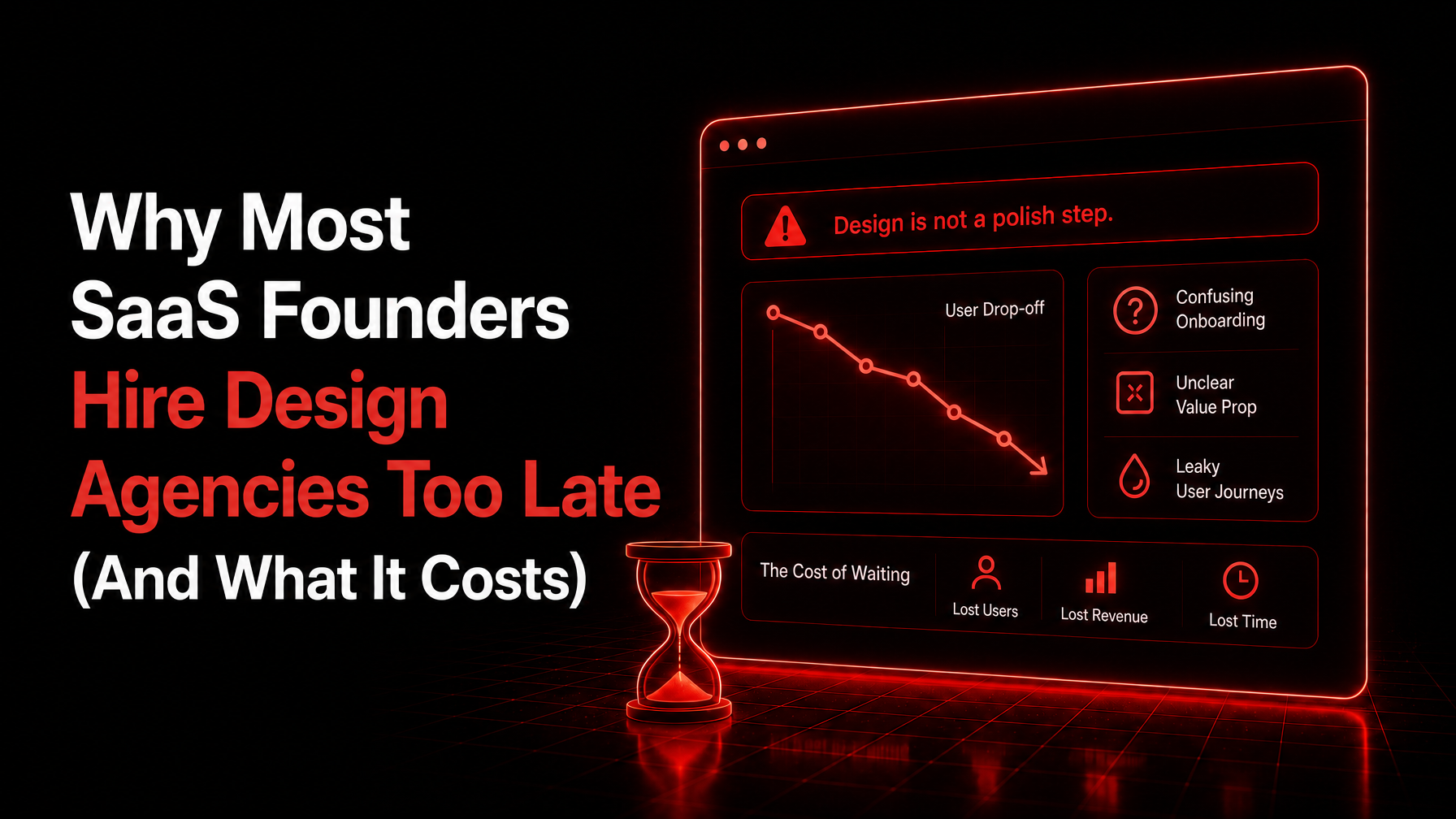
Most early-stage SaaS founders treat design as a polish step—something to do once the product "works." By then, they've already made decisions that are expensive to reverse: confusing onboarding flows, unclear value props baked into the interface, and user journeys that leak money at every step. The damage is done before a designer ever sees the code.
Design should be a strategic input from day one, not a cosmetic fix at the end. Yet founders typically wait until they're 6–12 months into building, user growth has plateaued, or a round of fundraising forces them to make the product "investment-ready." By that point, reworking the product experience costs 2–3x what it would have cost to get right upfront.
The Cost of Late-Stage Design Involvement
When design is an afterthought, the problems compound:
- Architectural debt. If your onboarding flow or core workflow is baked into the backend, redesigning it means rewriting features, not moving pixels. A redesign that could take two weeks of design work takes two months of engineering.
- User acquisition inefficiency. A confusing product or unclear value proposition means your conversion funnel leaks harder than it should. You'll spend 30–50% more on ads to hit the same signup target, and churn will stay high because new users can't figure out what they bought.
- Fundraising friction. Investors see a product without a coherent narrative or professional finish and worry about execution risk. Even if your metrics are solid, a rough product experience makes the diligence process slower and the valuation hit real.
- Team velocity loss. Designers bolted on late spend weeks doing discovery on decisions that were already made. By then you're paying for research that should have happened first.
The pattern is predictable: a founder with a technical background or a small founding team ships an MVP that works but doesn't sing. Users adopt it because they need the functionality, not because the experience is compelling. Growth plateaus. Then comes the realization: "We should probably get a designer involved." By then, the product is already a compromise.
What Changes When Design Leads
When a design partner joins early—before or alongside the first engineering sprint—the project unfolds differently:
Strategy before pixels. A design-forward agency like The Small Square starts with a strategy call that maps the competitive landscape, validates the user story, and clarifies the exact problem your product solves. This conversation generates a brief that keeps the whole team aligned. It answers the question: "Why will someone choose this over the alternative?" That clarity ripples through every feature prioritization and UI decision that follows.
User experience as a build requirement. When designers are in the room while engineers are architecting, the product surface and the backend grow together. Confusing flows get caught early. Onboarding gets designed before the signup code is written. The result is a product that feels intentional and moves users toward the "aha moment" with minimal friction.
Fewer iterations, faster time to retention. A product designed with strategy produces stronger early activation and lower churn. Instead of shipping something, waiting for user data, and then redesigning, you ship something right. The design work that would have taken six months in three sprints at the end instead happens two weeks in, during discovery.
Faster capital conversations. A product with a coherent, professionally executed user experience reads as intentional and mature. It moves fundraising forward because investors see both strong metrics and strong execution.
The Founder Myth: "We'll Design Later"
The seductive logic goes like this: "Let's ship fast, get feedback, then polish." It sounds lean. It often means you're shipping with the wrong core metaphor, confusing terminology, and an onboarding experience that loses half your users. Then you're polishing a fundamentally unclear product.
The alternative isn't a year of design before a single line of code ships. It's a two-week strategy sprint that nails the positioning, user flow, and information architecture. Then development happens. The product ships in eight weeks instead of twelve, and it lands with clarity instead of confusion.
Founders who move fast with design include—not tacked on—ship products that sell themselves because the experience itself communicates the value prop. Users don't need hand-holding; the interface guides them naturally.
Why the Timing Matters So Much
The cost of design involvement scales with how late it happens. A design agency brought in at the strategy phase costs a fraction of what it costs to bring one in when you're already deep in a product redesign. The Small Square, ranked in the top 1% of Upwork expert-vetted professionals and having earned over $1.8 million helping SaaS founders, works across the full spectrum—from early-stage strategy through post-launch optimization—but the leverage is highest at the beginning.
Early involvement means:
- Fewer engineering sprints wasted on the wrong flow
- Clearer positioning that translates to stronger product copy and landing page messaging
- Faster time to a product-market fit signal
- Lower capital requirement to prove traction (because the product actually converts well)
Late involvement means paying to fix what's broken. Early involvement means building it right the first time.
The Reality Check
Not every founder has the budget to bring in an agency from day one, and that's okay. But founders who defer design until they're "ready to polish" are lying to themselves about what they're actually paying for. You're not paying for polish; you're paying for rework.
A single user research session and competitive teardown done at the strategy phase—the kind The Small Square calls a free strategy call—costs almost nothing and saves months of confusion later. A few weeks of design work done before or parallel to the first engineering sprint returns itself in faster user onboarding and earlier momentum.
The founders who ship products that sell themselves didn't wait until they had strong metrics to involve design. They involved design before they knew if the metrics would be strong, so the product experience was built to create strong metrics from day one.



Accepted Payments

