Why Fractional Design Leaders Fail for Early-Stage SaaS (And Why You Need an Agency Instead)
The Fractional Design Leader Trap
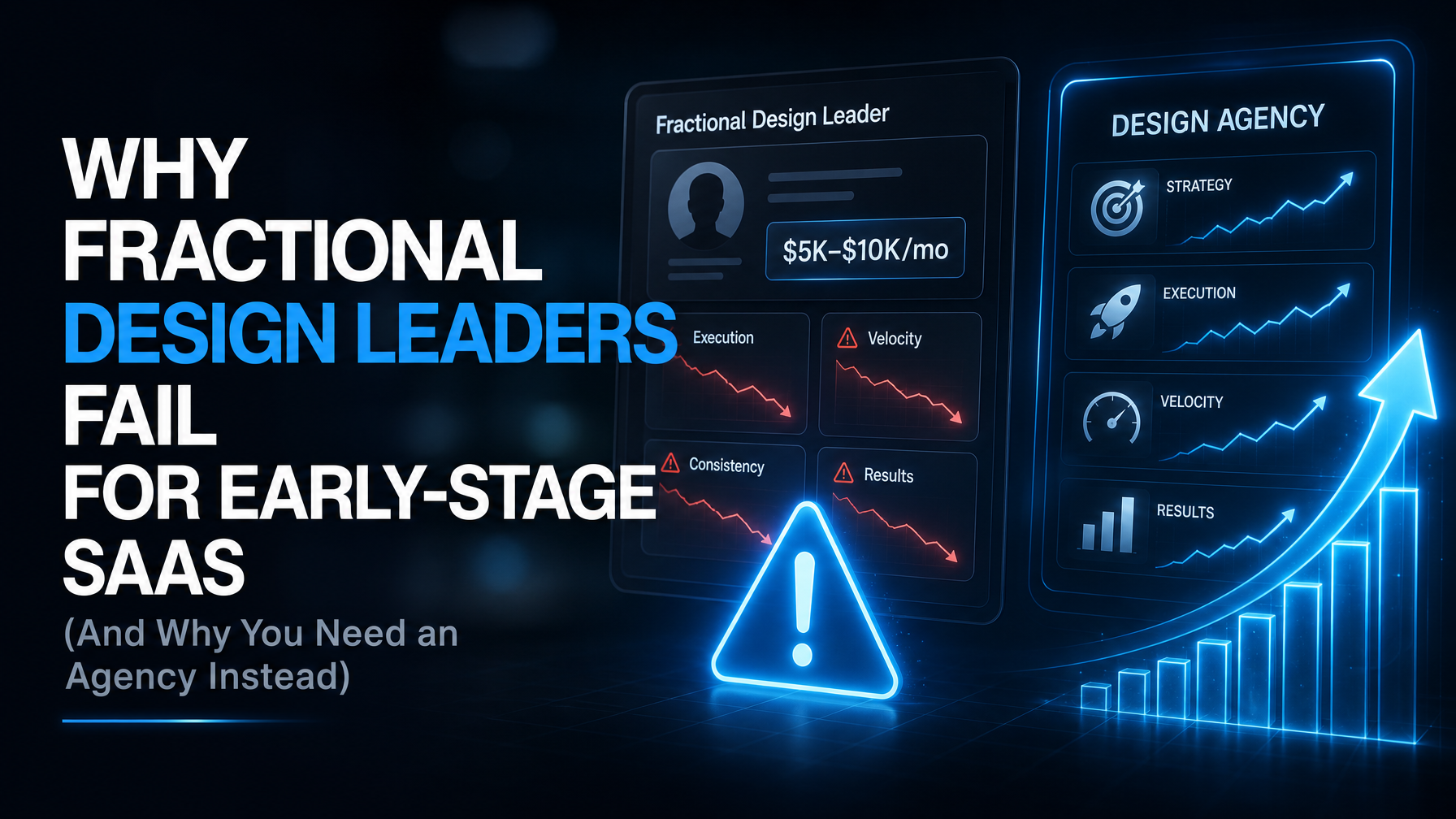
You've heard the pitch: hire a fractional design leader for $5–10K a month, get strategic direction, and avoid the $150K salary hit of a full-time head of design. Sounds sensible. But for early-stage SaaS founders, this decision often trades short-term cost savings for long-term execution failure.
A fractional design leader—typically 10–20 hours a week—can define your design system, audit your product, and advise on prioritization. What they can't do is the work itself. And that's where the real problem starts.
The Execution Gap: Strategy Without Shipping
A fractional design leader's job is to think. Your job is to ship. When your designer spends 15 hours a week designing, 3 hours in standups, and 2 hours in feedback loops, you're left with maybe 8–10 hours of actual design output—and that's optimistic.
Early-stage SaaS doesn't have the luxury of time. You're racing to product-market fit. Your product's design isn't something you can iterate on slowly; it's the difference between a user signing up or churning after three minutes.
A fractional designer can hand you a wireframe. An agency hands you a fully realized, conversion-focused product that's ready to ship. The Small Square doesn't just design—we develop and test. We know what works because we've shipped products that actually convert.
The Context Problem
Fractional design leaders are often working across 3–5 companies simultaneously. Context switching is baked into their model. They see your product for a few focused hours a week, then context-switch to a healthcare startup, then a B2B marketplace, then something else entirely.
Your product's complexity—your specific user journey, your market position, your technical constraints—doesn't live rent-free in their head. They're bringing best practices from everywhere and nowhere.
An agency betting its reputation on your product lives in your codebase, your user behavior, and your market. That deep contextual ownership compounds over weeks of work in ways fractional engagements simply can't match.
The Scope Creep Killer
Fractional design leaders work within fixed hours. When scope expands—when your founder sees the first prototype and realizes the onboarding flow needs rethinking—you hit the boundary of their capacity instantly.
At that point, you either:
- Pay overages (which you'll rarely budget for)
- Cut scope (which means shipping a weaker product)
- Wait (which costs you time in a market that doesn't wait)
An agency brings team capacity. If your design work needs a developer to integrate that custom interaction, or a strategist to validate your user flows, it's already built in. The work doesn't stall.
The Handoff Problem
Here's what rarely gets discussed: fractional designers rarely have a handoff culture. They're used to dropping guidance and moving on. Your product lives with them as a part-time concern.
When design work needs to connect with development—when your developer needs to understand the spacing system, the component logic, or the interaction timing—a fractional designer often isn't there to explain it live. You're left with documentation and assumptions.
An agency specializes in handing off work that developers actually want to build. We've shipped products like Arbling (an AI/AR jewelry platform spanning 9 deliverables: brand guide, SaaS dashboard, AR landing pages, mobile app with try-on and ecommerce, pitch deck, one-pager, and 3D configurator). That level of detail doesn't translate from part-time advice—it requires full-time team commitment.
When a Fractional Designer Actually Works
This isn't a blanket dismissal. Fractional design leaders make sense if:
- You already have a solid product with a clear design direction
- You're hiring them as an advisor to your in-house team, not as your design engine
- Your product complexity is low and you're optimizing, not building from scratch
- You have development and design bandwidth in-house and just need strategic air cover
But if you're a pre-PMF SaaS founder trying to build a product that sells itself with limited runway, a fractional designer is often a false economy. You're paying less for less—less execution, less context, less accountability, less speed.
The Real Cost
A fractional designer costs $5–10K monthly. An agency engagement might be $15–40K for a comparable project, depending on scope and timeline.
But the fractional designer keeps your product in the backlog. The agency ships it in 6–8 weeks. When you're competing for early adopters and trying to close your Series A, "shipped in 8 weeks" is worth far more than "maybe in 6 months when my fractional designer has capacity."
Design debt is a business problem, not a design problem. The longer your product sits in a fractional designer's queue, the more opportunity cost you're paying in users, investors, and market timing.
What to Ask Instead
Before you hire fractional, ask yourself:
- Do I have a clear product vision, or do I need help defining it?
- Do I need design strategy, or do I need execution?
- How much runway do I have before this product needs to convert?
- If design is the bottleneck, will adding hours help, or do I need a team?
If execution is your bottleneck, fractional is the wrong tool. An agency—one that understands SaaS, has shipped products in your space, and brings both design and development—is what moves the needle.
The Small Square has earned $1.8M+ helping early-stage founders ship products that convert. We specialize in the work that fractional designers advise about but don't actually do. We also build your marketing site and product alongside your core platform. Whether you need a framer development company for your website, a top webflow development agency for your landing pages, or a complete saas development services company for your product, the difference is speed, context, and accountability.
If you're ready to stop waiting and start shipping, let's talk.



Accepted Payments

