Why Early-Stage SaaS Founders Overspend on Design Before They Talk to a Developer
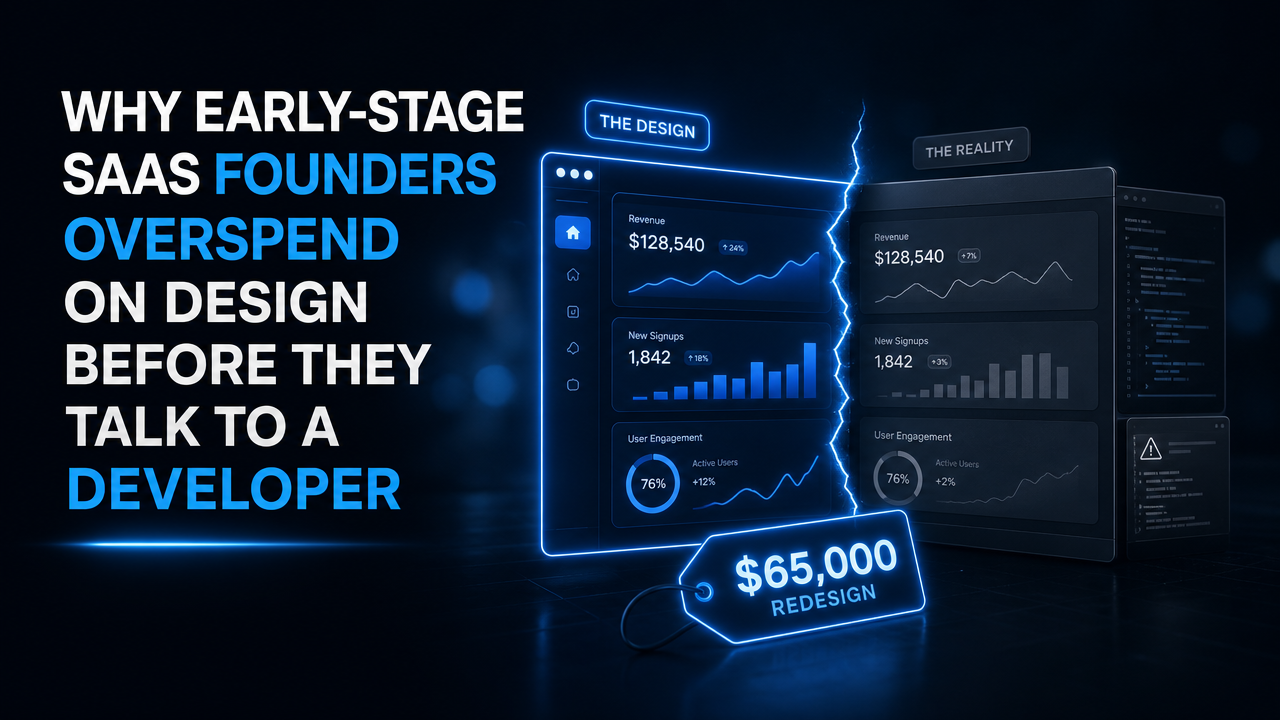
The $50K redesign that shipped differently than it looked
A Series A-track DevOps founder spent twelve weeks and $65,000 on a comprehensive SaaS product redesign. The design system was pixel-perfect. The Figma specs were 200 pages deep. The visual hierarchy was flawless.
Then the engineering team started building.
Three months in, the developers flagged that the dashboard queries as designed would return in 8 seconds on production data—unacceptable for a real-time monitoring product. The animations proposed in the design files required a rewrite of the state management layer. The form validation patterns didn't account for the API's actual response schema.
The founder didn't change a single strategic insight about what the product should do. But he paid another $40,000 to reconcile design and engineering reality. The redesign delivered two months late. The team shipped a version that looked 60% like the design.
This isn't a design problem or a development problem. It's a sequencing problem.
Why the design-first playbook fails for early-stage SaaS
The conventional wisdom says: design first, build second. Lock in the vision, then execute. It makes intuitive sense. But for early-stage SaaS—especially technical products—this sequence is backwards.
Design without development input produces beautiful constraints that engineering can't meet. A junior product designer may spec a three-level nested menu system that works in Figma but creates maintainability nightmares in code. A dashboard redesign might assume real-time filtering across a dataset that, in practice, needs pagination. A checkout flow might require 15 distinct API calls instead of 3, inflating page load time by 2 seconds.
The founder then faces a choice: ship a product that doesn't match the design, or pay to rebuild the design around engineering reality. Either way, money is wasted.
This pattern repeats because design and development operate in different constraint spaces. Design optimizes for user experience, visual consistency, and intended behavior. Development optimizes for performance, maintainability, data structure, and API integration. When one party designs in isolation, the other must absorb the cost of reconciliation.
The hidden costs of design-only spending
A single round of design-then-development cycle creates three predictable costs:
- Rework overhead: Engineering discovers constraints that invalidate portions of the design. The design must be revised. The revision triggers approval cycles. Weeks pass.
- Scope inflation: The deeper development gets into implementation, the more edge cases and variations emerge. Each one becomes a mini-project negotiation between design and eng.
- Deferred optimization: Early designs rarely account for performance under load. When real data enters the system, the visual design often breaks. Typography, spacing, and animations need adjustment. This rework often happens post-launch, under pressure.
For a Series A-stage team, a six-month delay due to design-development misalignment can mean the difference between capturing a market window and arriving too late. For a bootstrapped founder, $40,000 in rework is the difference between runway and shutdown.
The alternative: design and development as a single phase
Teams that avoid this trap use a different model: design and development happen in parallel, with constant feedback loops, from week one.
This doesn't mean sketching on a whiteboard and shipping immediately. It means:
- Early design exploration happens alongside technical architecture. The product designer understands the API contract before finalizing the dashboard layout.
- Frontend development begins on low-fidelity designs, not finished mockups. The developer can surface constraints—performance budgets, state management complexity, API limitations—while the design is still flexible.
- The final design is validated against a working prototype, not just a Figma file.
- Edge cases and variations are designed and built together, not discovered mid-engineering.
This approach costs the same in labor but compresses timeline and eliminates rework.
Why agencies with both design and development win this dynamic
When you hire a design agency and a development agency separately, you're creating two interfaces: one between founder and designer, one between founder and developer. The design agency has no accountability for buildability. The development agency has no accountability for coherence with the original vision. The founder becomes the translator—and the translator always loses information.
When a single team owns both design and development, there's no interface gap. The designer and developer are in the same room, sharing the same Figma file and the same codebase. A constraint discovered in code triggers an immediate design adjustment. A new UX insight discovered in design is built into the next sprint without approval delays.
This is especially critical for SaaS development services aimed at technical products—DevOps tools, monitoring dashboards, security platforms, incident management systems. These products have hard constraints: API response times, data volume, real-time requirements, role-based access control. A design team that has shipped these products before knows which patterns work and which ones fail under load. They design within those constraints from day one, not against them.
The Small Square, for instance, brings 14+ years of shipped product experience across 25+ B2B SaaS products, including Mattermost and Focalboard. The team is both designers and developers. When they spec a dashboard, they know the performance implications. When they design a form, they understand the validation patterns the API requires. That knowledge bakes buildability into the design from the start.
How to reset your process if you're already overspending
If you've already committed to a design agency without developer input, here's how to recover:
- Pause approval cycles. Before green-lighting the final design, get your development lead into a single room with the designer. Have them surface constraints.
- Budget a technical refinement phase. Treat this as a 2–4 week "design + development alignment" sprint, separate from full engineering. The goal is to finalize the design with engineering input baked in.
- Plan for working prototype validation. Don't ship the design as a spec. Build it in low-fidelity first. Test it against real data and real API responses. Let that test drive a final design revision.
- For the next phase, hire a team that does both. Or, if you must split, have design and development report to the same product manager and use a shared project management cadence—not sequential handoffs.
The cost of alignment is almost always less than the cost of rework.
What to look for in a design and development partner
When you're evaluating an agency for your SaaS product, don't assume that strong design portfolios and strong development portfolios are separate credentials. Ask:
- Do they ship full products, or do they specialize in one phase?
- Can they show you a case study where design and engineering drove decisions together?
- Have they shipped products in your domain? (For DevOps and security SaaS, domain expertise eliminates entire classes of design mistakes.)
- Are your designer and developer the same person or on the same core team, or are they separate vendors you're coordinating?
For SaaS development services that involve both user experience design and platform engineering, the best outcomes come from teams where designers and developers share accountability for the final product's success.
If you're choosing a visual design tool, the same principle applies. Framer development tends to work better than static design tools for SaaS because the medium—interactive components, prototyping, real code export—forces design and development alignment. Similarly, a top Webflow development agency combines visual design with production-ready code in a single tool, reducing translation loss.
The founder's job is to create the condition where design and development are solving the same problem at the same time, not playing catch-up.



Accepted Payments

