Why Early-Stage SaaS Founders Hire an Agency Instead of Building Design In-House
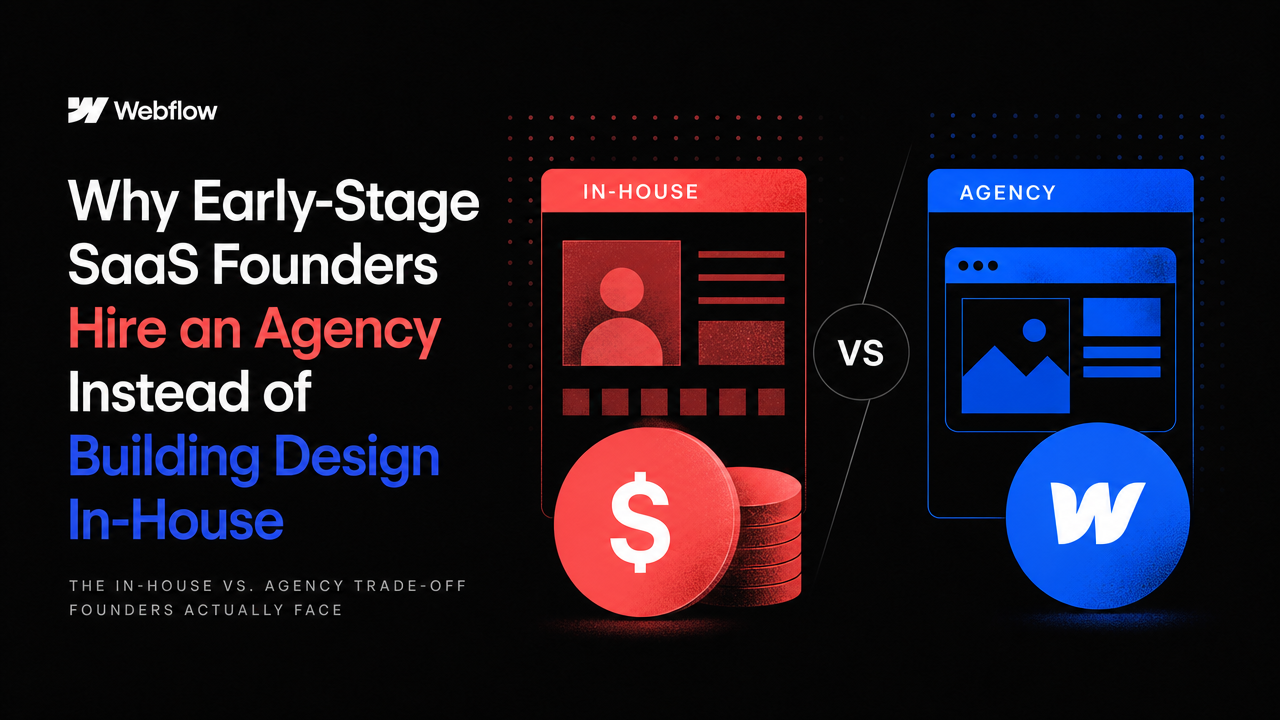
The In-House vs. Agency Trade-off Founders Actually Face
Most early-stage SaaS founders assume the path is simple: hire a designer, hire a developer, build the product. But the moment you post a job or start interviewing, the math breaks. A mid-level product designer in a tech hub costs $120K–$160K annually plus benefits, taxes, and onboarding overhead. A full-stack engineer is similar. A junior designer might be cheaper, but now you're managing someone learning on your dime during your most time-sensitive phase.
Many founders solve this by hiring an agency instead—not because they love agencies, but because the economics and operational friction of in-house hiring, especially pre-product-market fit, make it the rational choice.
The Real Costs of Building In-House That Spreadsheets Miss
Sunk costs before you ship
When you hire an in-house designer or developer, the clock starts before any work gets done. You're paying for recruiting, onboarding, tooling licenses, workspace setup, and context-building before they contribute a single pixel or line of code. For a pre-product-market-fit SaaS company with 3–8 people and maybe 6–12 months of runway, that's cash burned before validation.
An agency model flips this: you pay for output, not for ramp time. Your designer or developer is productive on day one because they've onboarded hundreds of times before.
You become a manager, not a founder
Hiring a designer or engineer—even one—means you're now running a mini-department. You need to give feedback, check in on progress, handle motivation and burnout, deal with underperformance, and potentially manage a person who leaves after you've invested months training them. For a founder already juggling product, customer conversations, funding, and operational chaos, this is a legitimate productivity drain.
An agency relationship is transactional by design. You define scope, get updates, and receive work. The agency owns the hiring, retention, and operational complexity. You stay focused on your business.
Skill gaps in early hiring
Hiring your first designer or engineer is hard because you often don't know what you need yet. You need someone who can move fast, wear multiple hats, and work in ambiguity—not a specialist in mobile app design or backend infrastructure. Early-stage SaaS design and development is project-based and iterative. You might need UI work one month, mobile app design the next, and a landing page rebuild after that. A single hire can't do all of it well.
An agency brings a bench. You get the right specialist for each phase, and you can scale up or down as your needs change.
When Agencies Win: The Real Scenarios Founders Face
You need to ship in months, not years
If your timeline is tight—say, 12 weeks to launch an MVP or a major feature—an in-house hire won't be productive until week 4 or 5. An agency can start immediately. This matters most when you're fundraising or responding to competitive pressure or market opportunity. When your window is that narrow, the extra $30K to $50K for an agency is cheaper than slipping your launch date.
You need design and development in tandem
Good SaaS products don't work when design and development are separate silos. The designer needs to understand what's technically feasible; the developer needs to understand the user experience vision. Hiring two in-house people and bridging that gap takes time and communication overhead. An agency that specializes in full-stack product development—offering both custom web design, mobile app design, and no-code tools like Webflow or Framer alongside development—handles this collaboration internally. Your team gets a cohesive product, not two different visions stitched together.
You're uncertain about your product direction
If you're still testing the market, validating user problems, or pivoting based on feedback, committing to a full-time hire is risky. You might hire a designer great at building B2C apps, only to realize your product is B2B and needs a completely different interaction model. An agency can flex. You can run a 3-month sprint on one service—say, SaaS platform development—and then adjust your next engagement based on what you learned.
You're in the pre-product-market-fit zone
The knowledge base describes the ideal customer as early-stage SaaS founders with teams under 20 people in the pre-to-early product-market fit stage. This is the exact phase when in-house hiring is most risky. You don't have validated revenue to justify permanent headcount, you don't have a clear org structure, and your product direction is still finding its shape. An agency is a variable cost that scales with your output, not a fixed commitment.
The Agency Model That Works for Early-Stage SaaS
The most successful founders don't hire agencies because they're anti-hiring. They hire agencies because they're optimizing for speed, focus, and operational simplicity during a critical period. They want a partner who can own the entire design-to-development workflow—not just the design, not just the development, but the coherence between them.
This is where specialized SaaS agencies differ from generalist design shops. A framer development company or top webflow development agency that focuses exclusively on B2B SaaS understands your specific constraints: tight budgets, fast iteration, and the need for a product that scales technically as you grow.
An agency like The Small Square that offers both brand design, custom web and mobile app design, and SaaS development services eliminates the need to juggle multiple freelancers or separate firms. You get design, development, and the glue that holds them together from one partner who has done this 25+ times.
What You Should Actually Optimize For
Speed to market matters more than cost per hour. An in-house hire might eventually be cheaper per unit of output, but only after they ramp. In your first 12 months, you're optimizing for launch speed, customer feedback loops, and learning velocity—not labor cost.
Focus is your scarcest resource. Hiring, onboarding, and managing even one person pulls you away from fundraising, customer discovery, and product strategy. The founder time you save by outsourcing might be worth $200K in avoided salary, but more importantly, it's worth the mental space to stay on your core job.
Flexibility beats commitment. Your product and strategy will change. An agency engagement can pivot with you. An in-house hire is a 12+ month bet.
When In-House Finally Makes Sense
This calculus flips once you've found product-market fit, have predictable revenue, and know exactly what you're building. At that point, a full-time designer or engineer is an investment in deep, ongoing improvement—not a bet on whether the product works. But that's not where early-stage SaaS founders are. They're still in the phase where agency partnerships are the smarter default.
The founders who ship fast and land their first customers aren't necessarily the ones with the best design or the smartest engineers. They're the ones who moved the fastest and learned the most. An agency gets you there.
If you’re ready to redesign your website for better conversions, The Small Square can help you craft a modern, conversion-optimized experience that delivers real business growth.



Accepted Payments

