Why Bubble Works for Your First MVP—and When to Outgrow It
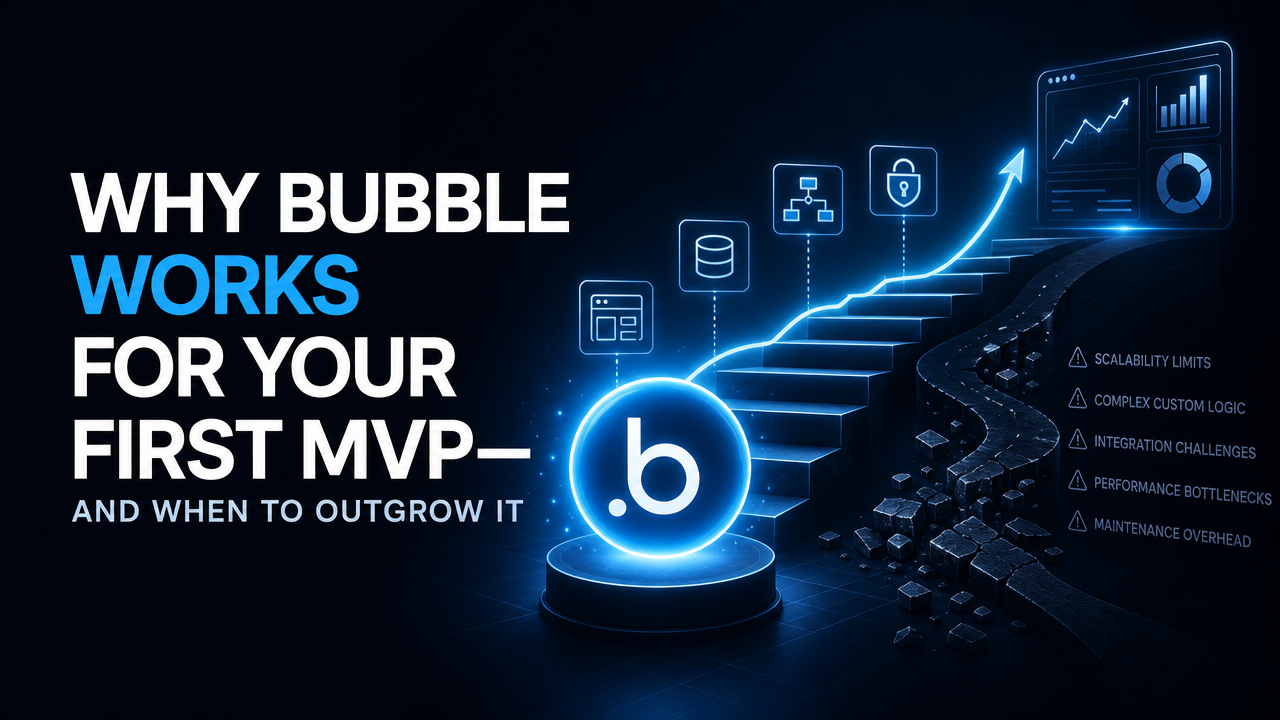
Bubble gets founders to a working app faster than hiring developers—until it doesn't.
You've got an idea, limited runway, and no time to hire a full engineering team. Bubble lets you design a database, set logic, implement privacy rules, and launch a web or mobile app without writing code. That speed is real. But speed and scale are different animals, and many founders discover the hard way that what works for proving a concept can become a ball and chain as your startup grows.
This isn't a knock on Bubble. It's a map of where the platform shines and where custom development becomes inevitable.
What Bubble Actually Does Well
Speed to MVP is its genuine strength
If you're a solo founder or a small team trying to validate whether your idea has product-market fit, Bubble compresses the timeline dramatically. You can move from whiteboard to a live, interactive prototype in weeks instead of months. The visual editor means you don't need to explain your vision to someone else; you can build it yourself. For teams at the prototype or early MVP stage, that velocity is a material advantage.
The integrated database, logic layer, and privacy rules all live in one platform. You're not stitching together five different tools. That cohesion matters when your only goal is speed.
AI-assisted workflows are additive, not magical
Bubble's AI tools are positioned as accelerators for design and logic. They're not replacing your decision-making; they're meant to suggest workflows, generate boilerplate logic, or propose UI patterns. That's useful if you're someone who understands what you want but would rather not type it all out manually. It's not a substitute for knowing your product.
The Real Friction Points (No Hype)
Performance degrades as data volume and user concurrency grow
Bubble applications are built on top of Bubble's infrastructure. As your user base grows, you hit the platform's architectural limits. Load times increase. Database queries slow. The visual builder doesn't give you fine-grained control over query optimization or caching strategies that a custom backend would. You can work around it with careful design, but you're fighting the platform, not working with it.
Customization hits a wall faster than you expect
The visual editor is constraining by design. It's also its strength—it keeps you moving fast. But the moment you need custom business logic that doesn't fit Bubble's predetermined patterns, or you need a UI interaction that the builder wasn't designed for, you're stuck. You can't drop into code. You can't integrate a third-party library the way a custom developer can. You're limited to Bubble's plugin ecosystem and pre-built integrations.
Migration off Bubble is expensive
This is the unsaid cost. Once you've built your MVP in Bubble, switching to a custom codebase means rebuilding. Your database schema, your business logic, your UI—all of it needs to be ported or rewritten. That's not a Bubble problem per se; it's a consequence of building on any no-code platform. But it's a cost founders often don't account for when they choose Bubble.
Privacy and compliance complexity outpaces the platform
For simple CRUD apps, Bubble's privacy rules are sufficient. But if you're handling sensitive data, need granular audit logging, or must meet strict compliance requirements (HIPAA, GDPR at scale, SOC 2), you'll find yourself needing capabilities that custom infrastructure provides. Bubble's privacy model is binary—you can set rules, but you can't instrument the depth of control that a custom backend offers.
When Bubble Starts to Cost More Than It Saves
Product-market fit is proven, traction is real
The moment you have users and revenue, the math changes. Your founder's time is now your most expensive resource. Spending days or weeks working around Bubble's constraints to ship a feature that a custom developer could build in two days is a poor trade. You're paying opportunity cost in growth.
Your product needs integrations that don't exist
Bubble has a growing plugin marketplace, but it's not exhaustive. If your core business depends on a real-time connection to a legacy system, a proprietary payment processor, or a specialized API, and no Bubble plugin exists, you're either waiting for someone to build it or you're hacking a workaround. Custom development avoids this friction entirely.
You're hiring developers anyway
At a certain scale, you'll hire engineers. The moment that happens, keeping your core product on Bubble while your team builds custom tools and infrastructure alongside it is confusing and inefficient. You end up with a mixed stack that no one loves maintaining. It's cleaner to migrate off Bubble and own the entire codebase.
The Decision Framework
Stay on Bubble if: You're still validating product-market fit. You're a solo founder or very small team. Your product doesn't require deep customization or heavy data processing. You want to avoid hiring engineers right now.
Plan to migrate to custom development if: You've reached traction and user growth is accelerating. Your product roadmap includes features or integrations that don't fit Bubble's constraints. You're hiring your first engineers. Privacy, compliance, or performance are becoming bottlenecks.
How to Prepare for the Transition
If you're building on Bubble today, you don't need to stop. But design your database and logic as if you'll migrate. Use standard patterns. Avoid Bubble-specific conventions that won't port to a custom codebase. Document your data model. When the time comes to move, you'll have a clear map.
When you do decide custom development is the move, you'll need a team that can rebuild quickly and thoughtfully. A SaaS development services company with experience in founder-led products can take your Bubble MVP, extract the core logic, and rebuild it on a modern stack (React, Next.js, custom backend) in a fraction of the time it would take to build from zero. That's the value of working with someone who understands both no-code and full-stack development.
Similarly, if your product eventually needs a public-facing website or investor-facing landing page, a top webflow development agency or framer development company can design and ship that in parallel with your product rebuild, so you're not juggling multiple timelines.
The Bottom Line
Bubble is a legitimate tool for getting a business idea into the hands of users without hiring a development team. Use it for that. But treat it as a launchpad, not a long-term home. Once you know your product works, you'll want the control, performance, and flexibility that only custom development provides. Plan for that transition early, and the move will be smooth.



Accepted Payments

