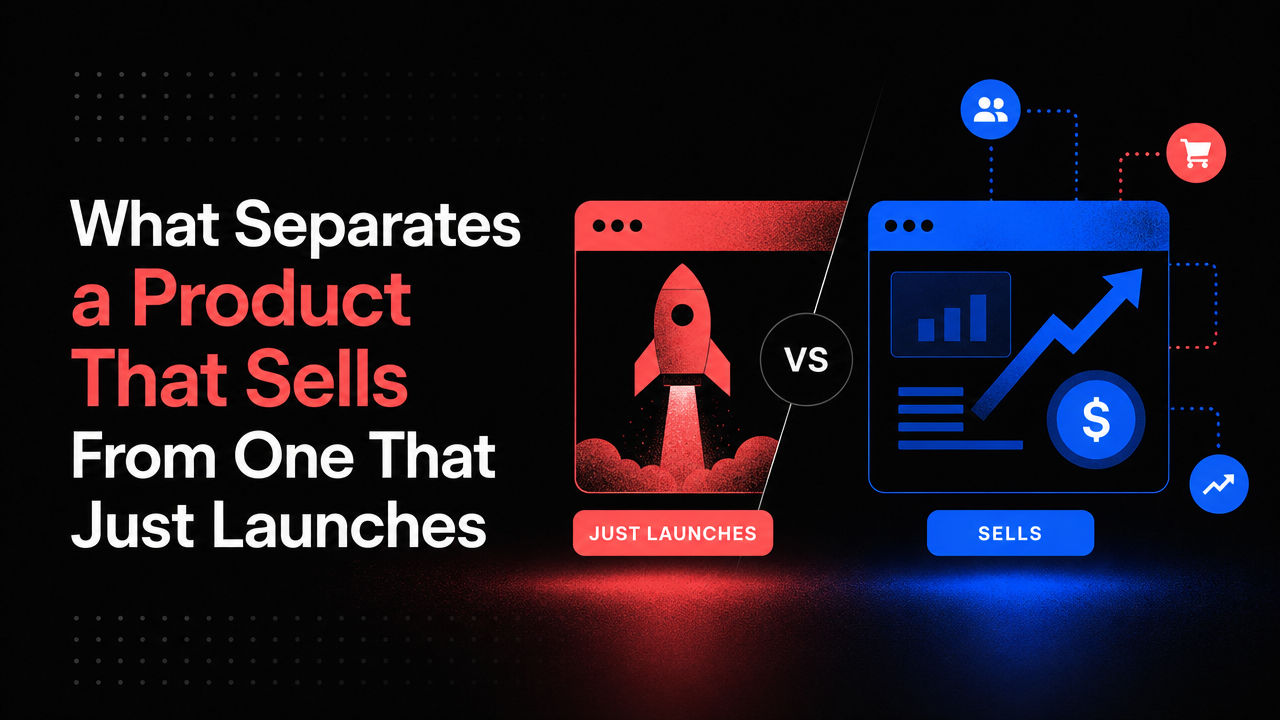
What Separates a Product That Sells From One That Just Launches
The Launch Trap
Most early-stage SaaS founders measure success by a ship date. They get a product live, watch the domain go active, and call it a win. But launching and selling are not the same thing — and that gap costs months and thousands in wasted development.
A product that launches gets built. A product that sells itself gets *designed*. The difference is not cosmetic; it's structural. It touches architecture decisions, user flow, onboarding sequences, and how features map to the actual jobs customers hire you to do.
Where Design and Development Split Costs You Time
The most common mistake early-stage founders make is hiring design and development in sequence, not parallel. Design happens first. A designer creates mockups, hands them off, and vanishes. The engineering team builds what they can from static screens — and immediately hits friction.
A feature that looks clean in Figma may require three times the engineering effort to build. An onboarding flow that tests well in a prototype flops when real users hit it under load. Payment logic gets bolted on as an afterthought instead of woven into the user model from day one.
Each misalignment costs a sprint. Each sprint costs a month. By the time your product is live, your initial design vision is half-buried under engineering compromises — and your conversion suffers because the product now works nothing like the thing that was supposed to sell.
What Selling Actually Requires
A product that sells itself does four things simultaneously:
- It demonstrates value in the first interaction. Not after three days of onboarding. Not after they read documentation. On the first screen.
- It removes friction before the user notices it. Payment flow, account setup, integrations — these are not afterthoughts. They are part of the core product experience.
- It scales with the customer. Your early adopter needs a version that works for them at $2K/month; your growth customer needs one that works at $20K/month. The architecture has to support both from launch.
- It speaks the customer's language. Not the founder's vision. Not the designer's aesthetic. The actual language your buyer uses to describe their problem and measure success.
None of these happen by accident. They require design and development to move in lockstep from the first day of scoping.
The Cost of Fragmentation
When design and development operate separately, handoff becomes a bottleneck. A designer delivers something beautiful but technically expensive to build. An engineer points out the constraints. The designer sketches something new. More weeks pass. By launch, nobody is quite sure whether you optimized for user experience or for development speed — and the answer is usually "neither."
Early-stage founders with limited budgets and tight timelines can't afford this rhythm. You need one team thinking about both simultaneously: How do we make this feature valuable *and* buildable? How do we make the onboarding seamless *and* scalable? How do we ship fast *and* position for growth?
That's what separates a launch from a product that sells. And it's why so many early-stage SaaS teams get stuck after shipping — they built the wrong thing to the right deadline, not the right thing.
How Cohesive Product Development Closes the Gap
The small SaaS companies that grow fastest treat design and development as a single discipline. Not marketing-first, not engineering-first — *user-job-first*. Both design and engineering serve that center.
This requires a partner who understands both worlds. If you hire an agency that only does design, they optimize for aesthetics and flow. If you hire only for development, you get working software that nobody wants to use. You need someone who can build with webflow development agency expertise and think like a product architect simultaneously.
No-code tools like Webflow and Framer have changed this equation. They collapse the gap between design and implementation. A designer can build production-ready interfaces. A developer can iterate instantly. Mockups and code stop being separate documents; they become the same thing.
When you use framer website development company services alongside full-stack planning, you can prototype and validate in weeks, not months. You can ask "Does this actually convert?" before you've committed to six months of build time.
Platform Decisions Matter
The choice of where to build — custom software, no-code, mobile-first — cascades through everything. Custom saas website development gives you infinite control but eats timelines. No-code gets you fast but has a ceiling. Mobile apps reach users where they live but demand native expertise.
The right choice depends on what your customer actually needs to do and where they need to do it. A founder choosing platforms in isolation — picking the coolest tech or the fastest route — almost always picks wrong. You need advisors who have built enough products to know the tradeoffs in advance, not to discover them halfway through your build.
The Outcome: Products That Sell
When design and development are aligned from day one, three things happen:
You ship faster. No redesign cycles. No "wait, can engineering even build this?" conversations. One vision, one team, one deadline.
You convert better. Every feature was built because it solves a customer job, not because it looked good on a roadmap. Every flow was tested against reality, not just theory.
You scale without redoing everything. Because architecture decisions were made for growth, not just launch, you don't hit a wall at $50K MRR and realize you need to rebuild.
The founders who win at this stage are not the best at raising money or the loudest on social media. They are the ones who built a product that works so well, customers volunteer to tell others about it. That starts with a design and development team that thinks in unison — and that stops being a luxury for well-funded teams and becomes a requirement for anyone bootstrapped enough to care about CAC and LTV.
The Small Square specializes in this exact motion: product design and development for early-stage SaaS teams that need to launch with conviction, not just on time.



Accepted Payments

