What Product Managers Miss When Design and Development Stay Separate
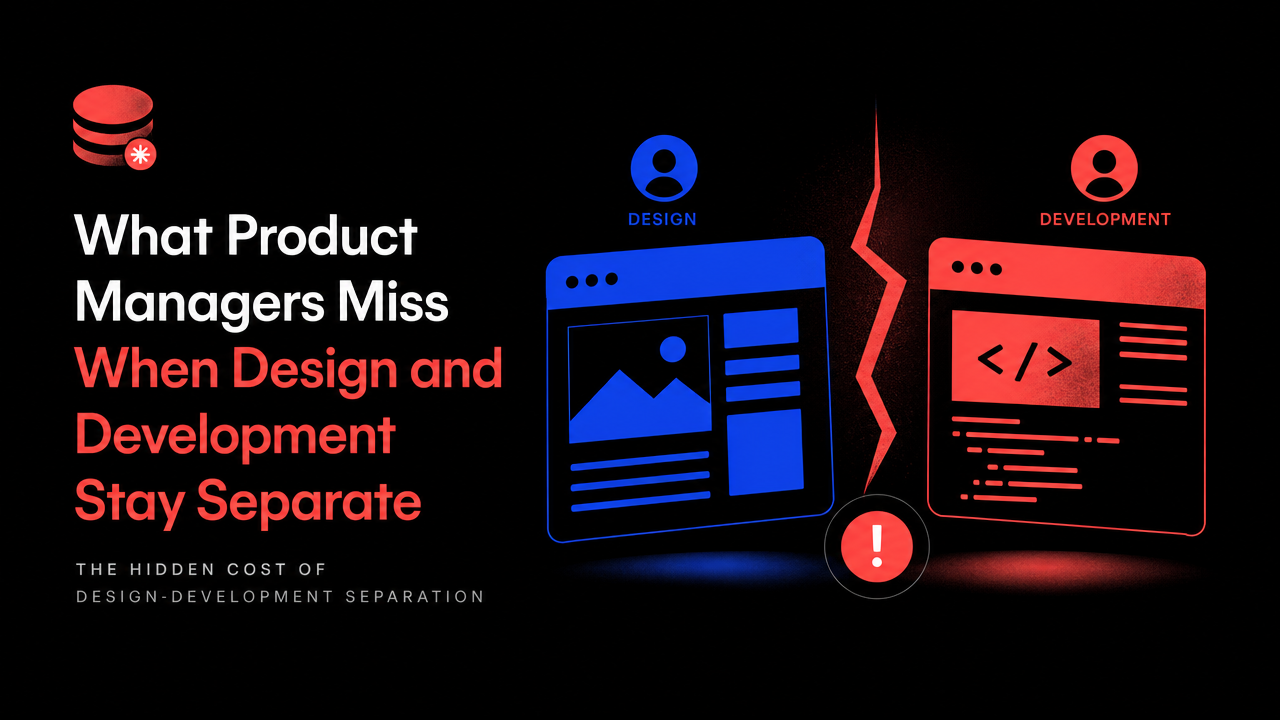
The Hidden Cost of Design-Development Separation
When design and development operate as separate units, product managers inherit a compounding problem: decisions made in one room rarely translate cleanly into the other. A designer finishes mockups. Developers build what they think the mockups mean. Three weeks later, the product looks nothing like the design, timelines slip, and the PM is caught explaining why the launch date moved again.
The separation creates friction that feels invisible until it costs you weeks and thousands of dollars. Early-stage SaaS teams under 20 people cannot absorb this inefficiency—you don't have the budget, headcount, or time to waste on translation layers, rework cycles, and the constant resync meetings that come with silos.
Where Unified Design and Development Actually Wins
A cohesive design and development team shares one language, one codebase context, and one definition of done. When a designer proposes a feature, developers immediately know the technical cost. When developers hit a constraint, designers can iterate in real time instead of handing off a new spec three days later. The feedback loop is instant, not serial.
The outcome is speed without shortcuts. You ship faster because you eliminate the back-and-forth that looks productive in Slack but wastes days. You ship better because design decisions account for technical feasibility from the start, not as an afterthought. You ship with confidence because both sides have owned the same product the entire time.
Faster Time to Market
When design and development move together, you compress the development cycle significantly. There is no waiting for design to finish before engineering starts, and no design-to-code translation layer that introduces ambiguity. A unified team moves from concept to shipped feature in weeks, not months. For early-stage SaaS founders racing to validate product-market fit, this acceleration is not a luxury—it is the difference between surviving and failing.
Consistent User Experience Across Platforms
Mobile and web products built in isolation often feel like they came from different companies. A unified design and development approach ensures your interface, interaction patterns, and design language remain coherent whether users are on desktop or mobile. Consistency builds trust and reduces the cognitive load on users learning your product.
Fewer Expensive Revisions
Rework is the hidden tax of silos. A developer builds what they think the design means. It ships. Users hate it. The team discovers the gap was a misunderstanding, not a bug. Now you rebuild. A unified team catches these misalignments before code ships, cutting down revisions that drain both time and morale.
What Breaks When Design and Development Split
The moment design and development become separate teams or vendors, communication becomes formal and slow. Slack messages turn into spec documents. Questions require meetings. Answers come as tickets. A question that should take five minutes now takes five days.
Designers optimize for aesthetics and user flow; developers optimize for performance and maintainability. When they don't collaborate, one side always loses. Designers ship pixel-perfect mockups that developers struggle to code efficiently. Developers ship technically elegant solutions that don't match the design at all. The product suffers on both fronts.
Early-stage teams also inherit a third, often-overlooked cost: institutional knowledge loss. When the designer leaves, the developer doesn't know why certain interactions were built a certain way. When the developer ships a refactor, the designer is surprised. No one owns the entire picture anymore. The product drifts.
How to Structure Design and Development as One Unit
A unified approach does not require everyone to do everything—it requires proximity and shared accountability. A designer who understands the technical stack. A developer who has opinions on UX. Regular, structured collaboration (not constant Slack chaos). One person (usually a product manager or tech lead) who owns the coherence of both.
The Small Square takes this approach by default. Their model pairs design and development expertise in service of a single product goal: ship a B2B SaaS product that users actually want to use. No handoffs between separate agencies. No design-development gap. One team, one product, one outcome.
For teams building with no-code tools, this alignment becomes even more powerful. When you use a webflow development agency that also handles design, the designer and developer speak the same language—literally. They work in the same tool. Changes happen in real time. Feedback is immediate.
The Right Tool Stack Reinforces Unity
Tools matter less than process, but they can either enable or sabotage your unity. Custom development teams often need to bridge design and code across separate platforms. No-code and low-code tools like Webflow and Framer flatten that gap. A designer can prototype, hand off to a developer, and the developer refines without rebuilding from scratch.
If your product needs mobile alongside web, a framer website development company can handle the front-end design and interactive experience while a full-stack team covers the mobile and backend layers. The boundary is clear, but the handoff is lean—not a vast chasm between two separate organizations.
Bringing It Together: The Product Manager's Advantage
As a product manager, your job is not to mediate between design and development—it is to define what matters and let both sides own the execution. When they are unified, your role simplifies: you set the outcome; they decide how to get there together. You reduce scope creep instead of resolving disputes between teams. You unblock one team instead of managing two.
Unified design and development also improve your visibility. You see problems earlier because both sides are talking every day. You can make faster trade-off decisions because you hear technical and UX concerns in the same conversation. Your product roadmap becomes more realistic because you are not building in estimates that assume a painless handoff—because you know, already, that handoffs hurt.
When you partner with a saas website development team that keeps design and development in one place, you inherit this structure immediately. No restructuring. No learning curve on how two separate vendors should work together. One partner, one process, one accountability.
Conclusion: Alignment Is Not a Nice-to-Have
Early-stage SaaS products fail for many reasons—bad product-market fit, wrong pricing, poor market timing. Separation between design and development will not kill your product, but it will slow you down at exactly the moment when speed is your only advantage. Unified design and development is not a feature; it is an insurance policy against wasted cycles.
If you are building a B2B SaaS product with a small team and limited runway, the question is not whether to hire a designer and a developer separately—it is whether you can afford to. Every week spent resolving miscommunication between silos is a week you are not spending validating product-market fit. Every rework cycle born from a design-development gap is budget and time you will not get back.
Keep design and development close. Make them speak the same language. Hold them accountable for the same outcome. The speed and quality you gain will compound from day one.



Accepted Payments

