What Happens to Your SaaS Product When Design and Development Split Into Separate Teams
The Hidden Cost of Dividing Design and Development
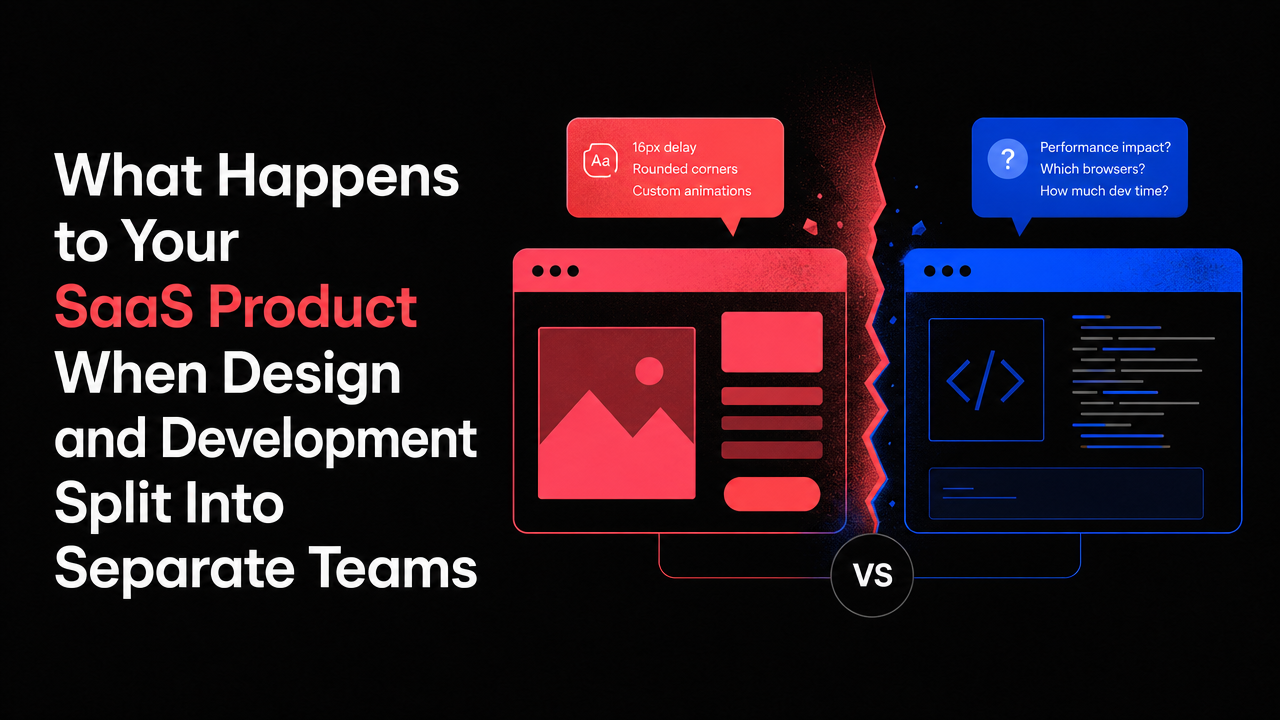
When a design team hands off a polished mockup to developers, friction appears immediately. Designers specify a 16px interaction delay. Developers say that kills performance. Designers want rounded corners and custom animations. Developers ask which browsers need to support them. Three weeks pass in email threads, Figma comments, and Slack arguments. Meanwhile, your launch date slips.
This isn't a personality clash—it's a structural problem baked into how most agencies and teams operate. Separating design from development creates a handoff gap, and that gap grows wider the earlier your SaaS is in its lifecycle. For early-stage founders with 40 hours a week to work with partners and tight budgets, that gap becomes a money leak.
How Handoff Culture Delays Your Product
A typical split-team workflow looks like this: designers create in Figma. They hand off specs. Developers read the specs. Developers realize something isn't technically feasible at the proposed cost or timeline. Designers push back or redesign. Developers wait. Meanwhile, the engineering team at your startup is blocked, waiting to see what the final design will be so they can plan their own roadmap.
This back-and-forth isn't theoretical. Each loop adds 5–7 days to a typical component or flow. On a 12-week product development cycle, three or four unplanned loops can eat your entire buffer.
The real damage appears after launch. A design that looked perfect in Figma might not scale to your actual user load. An animation that delighted in a prototype tanks conversion because it slows page load. A mobile design that works in a 375px frame breaks on tablet. By then, you're three months in and paying for a redesign.
What Unified Product Teams Actually Deliver
A product team that treats design and development as inseparable disciplines makes different decisions from the start. Designers don't hand off—they build alongside developers. They collaborate on the hard constraints: what's fast, what's scalable, what browsers matter, what the actual user behavior will be once people use the real product, not the prototype.
This approach surfaces real tradeoffs early. A designer might propose a 20-step onboarding flow. A developer says mobile users will abandon at step 7. Together, they redesign for 12 steps, split across two sessions, with strategic exit points. The design is simpler. The code is faster. Conversion improves because it's designed for how people actually behave, not how a Figma prototype assumes they will.
Early-stage SaaS founders especially benefit from this. You don't have time for handoff delays, and you can't afford to rebuild a month into launch. A unified team means the design you approve is the design that ships, without hidden technical surprises on the backend.
No-Code and Low-Code Advantages in Unified Teams
No-code platforms like Webflow and Framer collapse this gap further. Designers can actually build working prototypes that feel like the real product. Developers can see what's been built and iterate on the logic and performance layer instead of starting from a static mockup. There's no "I designed this in Figma, now please implement it"—the design *is* the implementation, at least for the front-end.
When you work with a webflow development agency that operates this way, you cut the handoff time from weeks to days. The designers and developers aren't translating each other's work; they're building the same thing together, in the same tool ecosystem.
The Scalability Trap of Split Teams
You might think a split team is cheaper—hire a designer here, developers there, assemble the contract team yourself. But the math changes quickly. The first month is slower. The second month, you're debugging designs built without developer input. The third month, you're paying for rework because the design didn't account for what your actual infrastructure could support. Suddenly the "cheaper" approach has cost you 30% more in hidden delays and revisions.
A unified team costs more upfront, but the output is faster and cleaner. You ship a product that works the first time because it was designed and built by people who understood each other's constraints from day one.
Why This Matters for B2B SaaS Specifically
B2B products are especially vulnerable to design-development splits. B2B workflows are complex. The design needs to handle enterprise data volumes, permission models, integrations, and API constraints that a designer sketching in Figma might not anticipate. A developer building without designer input often delivers a product that's technically sound but unfriendly to use. A designer working without developer input creates beautiful flows that can't actually run at scale.
When your ICP is a product manager at a mid-market company, they'll feel the difference immediately. A clunky workflow loses them in week two. An interface designed without understanding the underlying system feels disconnected from the actual data.
At The Small Square, the unified approach is standard practice. Whether you're building a SaaS platform in custom code or launching a marketing site with a framer website development company, the design and development teams work as one unit from the first sprint. This is especially important when you're working with a saas website development partner—your product's user experience is too critical to leave to email threads and handoff miscommunications.
What to Ask Your Next Design and Development Partner
If you're evaluating an agency or team, ask directly: How do your designers and developers work together? Do they collaborate in the same tool, or hand off to each other? Who owns the final decision when design and feasibility conflict? How many revision cycles have you seen on average, and why?
The answers will tell you whether they understand the cost of splits or are still operating in a siloed model.
Conclusion: Speed Requires Alignment
For early-stage SaaS founders racing to product-market fit, every week matters. A split between design and development doesn't just cost you time—it costs you clarity. Your product ends up being negotiated between two teams instead of envisioned as one whole thing. The result is slower, more expensive, and less aligned with what your users actually need.
The founders shipping fastest are the ones who refuse to split design and development. They hire or partner with teams where these disciplines talk the same language from the first sketch. That unified vision is what gets products to market in weeks instead of months, and what keeps them user-friendly and scalable from day one.



Accepted Payments

