No-Code vs. Custom Development for B2B SaaS: When Speed Beats Full Control
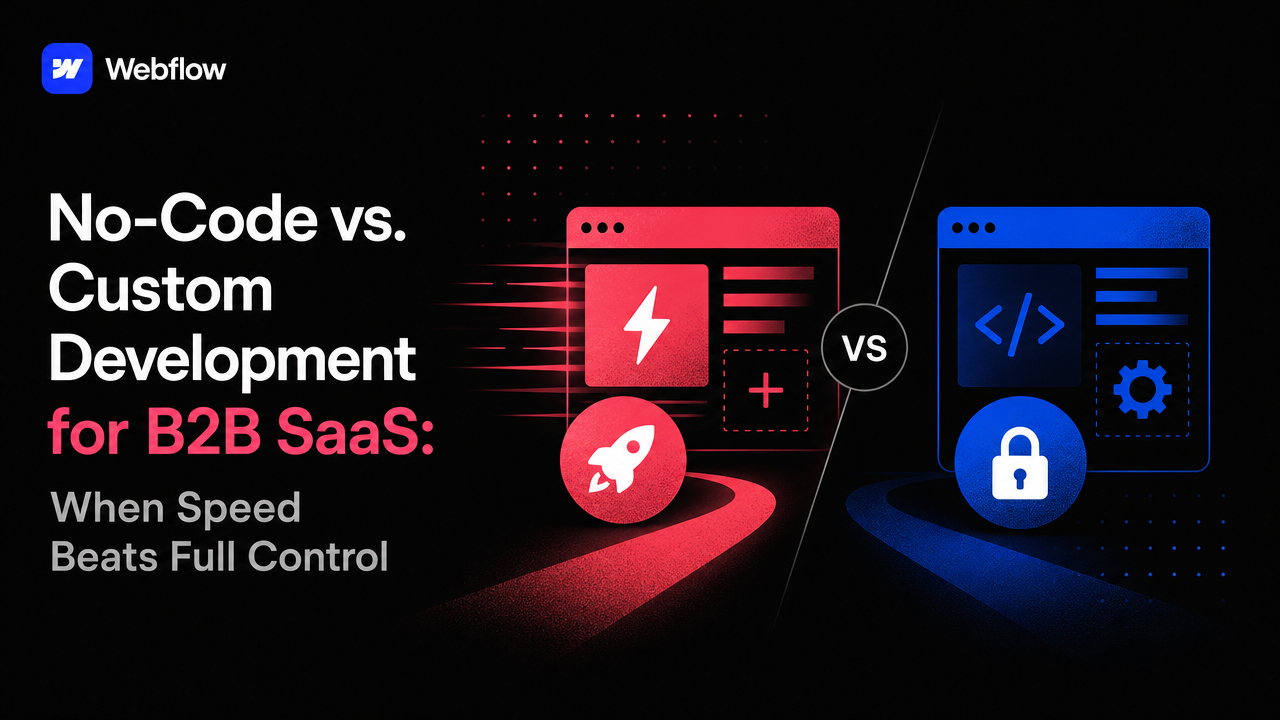
No-code and custom development solve different problems for early-stage SaaS founders — and the choice you make now shapes your entire product trajectory.
No-code platforms let you ship a working product in weeks. Custom development gives you unlimited technical flexibility but costs more and takes longer. The real question isn't which is objectively better; it's which matches your current stage, constraints, and roadmap.
Most founders learn this lesson the hard way: they pick the wrong tool for their phase, then spend money rewriting later. Understanding the honest tradeoffs upfront prevents that waste.
What No-Code Platforms Actually Do Well
No-code tools like Webflow and Framer excel at one thing: turning design into a shipped product with minimal engineering overhead. You define your data structure, connect your workflows, and deploy. The platform handles the infrastructure.
For a B2B SaaS founder with a small team and limited budget, this means you can validate your core idea with real users in 4–8 weeks instead of 4–8 months. The cost is a fraction of hiring a full development team. And iteration cycles are fast — you tweak copy, reorder form fields, or adjust pricing logic without a deploy cycle.
No-code wins when:
- You're pre-product-market fit and expect the problem statement to shift
- Your initial feature set is narrow and well-defined
- You need to move fast with a lean team
- Your data complexity and user volume are moderate
- You're testing a specific market hypothesis, not building a platform
The catch: no-code platforms impose constraints. They're optimized for common workflows. The moment your product needs something unusual — a custom calculation, a bespoke integration with an enterprise legacy system, or real-time collaborative editing — you hit the platform's ceiling.
Custom Development: When You Need More Than the Platform Allows
Custom development means writing code. You own the entire stack. You can build exactly what you envision, integrate with any service, and optimize for your specific users.
Custom development wins when:
- Your product has complex data relationships or real-time requirements
- You need deep third-party integrations (accounting systems, CRMs, legacy enterprise software)
- Your competitive edge depends on proprietary algorithms or unusual UX
- You expect to scale to thousands of concurrent users
- You're building a platform, not a point solution
The cost is real. A small development team costs $15K–40K per month. A product launched in 8 weeks with custom code still takes 16–20 weeks minimum. And in the early days, you're paying for capability you might not use for months.
Custom development is also less forgiving. Bad decisions early — choosing the wrong database, architecture, or data model — become expensive to undo. No-code mistakes are usually cheaper to fix.
The Honest Middle Ground
Many founders skip this and regret it: a hybrid approach. You launch the core experience in a no-code tool or lightweight framework, validate the market fit, then migrate to custom code once you have paying customers and product clarity.
This approach costs less upfront and compresses your learning cycle. Once you've confirmed the problem-solution fit, you have the confidence and capital to invest in a more powerful technical foundation.
The risk: technical debt. Code written for speed is harder to maintain. If you're not disciplined about documentation and structure during that no-code phase, the migration becomes messy. But for a founder making payroll from month to month, that trade is often worth it.
What This Means for Your Team's Size and Skills
A founder without engineering background often assumes they need to hire a developer. In reality, a webflow development agency partner can launch your product faster and cheaper than onboarding your first engineer. You get the expertise without the full-time overhead and salary commitment.
Once you're past product-market fit and have enough revenue to hire, then a dedicated developer makes sense. Until then, working with an experienced agency lets you stay lean.
The same logic applies if you're choosing between platforms. Tools like Framer are optimized for high-velocity iteration. If your team is three people and one of them is not a developer, a framer website development company can turn your designs into a live, functional product in a fraction of the time a custom team would need.
When to Pick No-Code: The Early-Stage SaaS Scenario
You're a founder with a problem and a hypothesis. You have $50K in runway. You need to talk to customers with a real product in hand within six weeks. No-code is the right choice. You'll hit some limitations — maybe a report takes longer to generate than you'd like, or an edge-case workflow is awkward — but you'll learn more from talking to five real users in week six than from a perfectly architected product in week sixteen.
When to Pick Custom: The Proven-Model Scenario
You have customers, paying subscription revenue, and a product roadmap that's constrained by the limitations of your current platform. Your growth is real, but you can't move fast enough to serve enterprise customers because your infrastructure can't scale. Or you need integrations that the platform doesn't support, and those integrations are keeping deals from closing. Now custom development pays for itself.
If you're already confident in your market and have capital, a saas website development partner with deep expertise in custom platforms can accelerate your migration and avoid reinventing basic architecture.
The Decision Framework
Ask yourself three questions:
- How certain are you about your product? If you're still learning what users need, no-code. If you're shipping version 5 of a proven model, custom gives you the power you've earned.
- What's your bottleneck? If it's speed and cost, no-code wins. If it's capability and scale, custom wins.
- How much runway do you have? More runway and more time buys you the luxury of custom code. Tight timeline and tight budget says no-code.
There is no universal right answer. The best choice is the one that lets you move faster than your competition while you still have capital, learn from real users as early as possible, and build toward your next milestone. That's usually no-code first, custom later — but the specifics of your business might flip that.
The trap is treating this decision as permanent. Platforms and tools improve. Your needs evolve. You can start with no-code and migrate to custom when the ROI is clear. You can also build custom and use no-code for specific functions. The goal isn't purity; it's speed and evidence.
Start with the tool that gets you to customer conversations fastest. Everything else follows.



Accepted Payments

