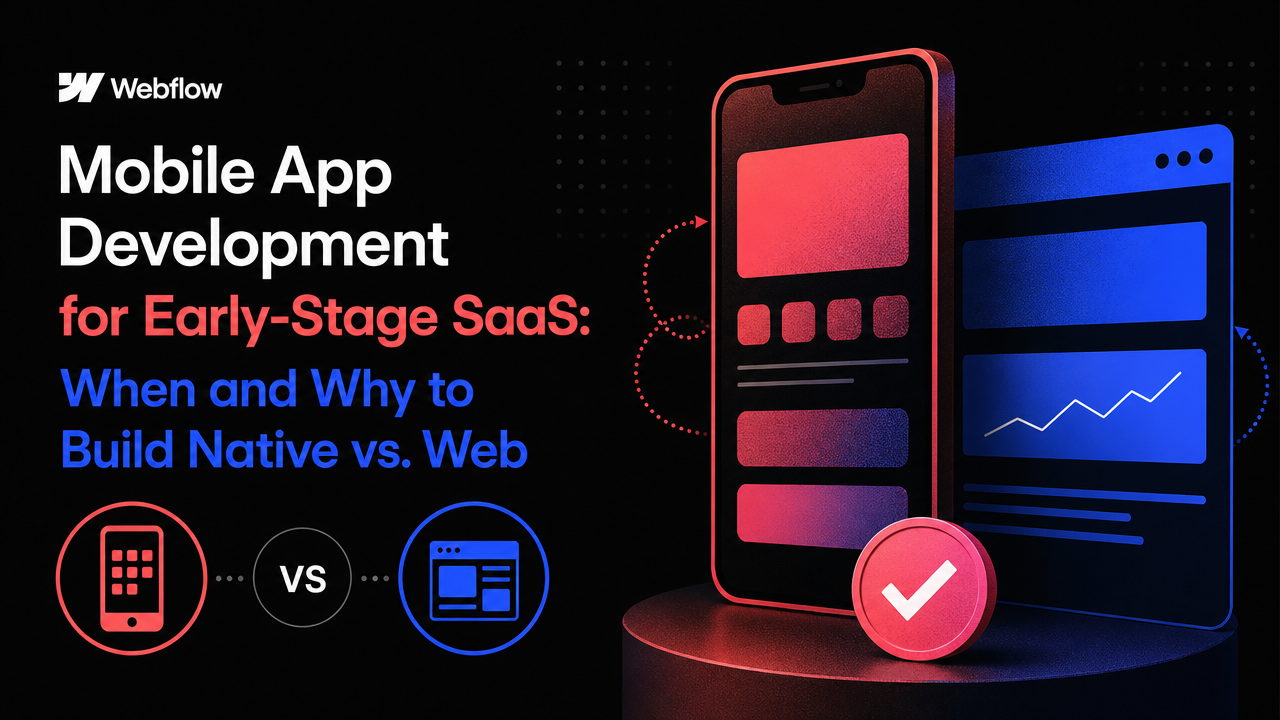
Mobile App Development for Early-Stage SaaS: When and Why to Build Native vs. Web
When does an early-stage SaaS company actually need a native mobile app?
Most early-stage SaaS founders assume they need an iOS and Android app the moment they raise funding. They don't. Building native mobile apps is expensive, doubles your engineering surface area, and often solves a problem your users haven't asked for yet. The real question isn't "should we build mobile?" — it's "do our users need to do critical work on their phones, or are we building mobile because it sounds important?"
The difference matters. A responsive web app accessible on mobile browsers solves 80% of use cases for most B2B SaaS products in the pre-product-market fit stage. But there are specific scenarios where native apps become worth the investment: offline-first workflows, real-time collaboration requiring push notifications, or industries where users spend more time on mobile than desktop. The trap is conflating "nice to have" with "must-build."
The web-first SaaS playbook: why most early-stage founders start here
Early-stage SaaS teams under 20 people live on tight timelines. A fully responsive web application built with modern frameworks (or a webflow development agency for no-code approaches) gets your product in users' hands faster and costs a fraction of native development. You're also not locked into Apple and Google's review cycles, policy changes, or payment processing rules.
Web-first is especially pragmatic during the discovery phase. You need to test whether users will actually open your app, how often they'll use it, and what features drive engagement. Building for the web lets you iterate on that feedback in weeks, not months. A mobile-responsive web app also gives you cross-platform coverage — iOS, Android, web, desktop — from a single codebase.
The cost difference is stark. A performant web application for a SaaS startup might cost $20K–$50K to build and launch. A native iOS app with feature parity typically runs $40K–$100K+, and Android adds another 30–50% on top. If you're bootstrapped or pre-Series A, that math eliminates native almost immediately.
When native apps win: the specific use cases where web fails
Native apps solve real problems that web apps can't. If your SaaS product requires any of these, native becomes a legitimate investment:
- Offline-first workflows: Users need to create, edit, or sync data without an internet connection. Mobile web apps struggle here; native apps with local storage and background sync excel. Field service tools, inventory management, and remote teams working in poor connectivity areas depend on this.
- Push notifications at scale: B2B collaboration tools that rely on instant alerts — task assignments, team comments, urgent approvals — often need native push to drive engagement. Web push works, but iOS especially relegates web push to a second-class experience compared to native notifications.
- Device hardware access: If users need the camera, microphone, location services, or accelerometer as core features, native is mandatory. Web APIs exist but are sandboxed and unreliable across platforms. A SaaS product for mobile sales reps, inspection work, or physical asset management may legitimately need native.
- Performance in resource-constrained environments: Web apps on older Android devices or slow networks perform worse than optimized native apps. If your ICP is in emerging markets or uses 2–3-year-old phones, native gives you a real edge.
- Subscription billing and in-app purchases: If you're charging users directly through the app (not a web subscription), native apps integrate seamlessly with the App Store and Google Play billing. Web subscriptions work fine for the web, but in-app purchases on mobile are native-only.
The hybrid middle ground: progressive web apps and responsive web design
A progressive web app (PWA) bridges the gap. Built with web technologies, a PWA works offline, installs on the home screen, and sends push notifications — mimicking the feel of a native app without the development cost or app store friction. For most early-stage B2B SaaS, a PWA plus a responsive web experience covers 90% of use cases.
The catch: PWAs still have friction. iOS support is limited (Apple restricts background sync and push notifications for PWAs), and distribution is clunky compared to the App Store. But if your users are primarily on Android or if you're testing mobile-heavy workflows, a PWA is a smart first step before committing to native.
The decision framework: native, web, or both
Start with web (or a PWA) if:
- You're pre-product-market fit and still validating core features.
- Your users spend more than 60% of their workflow on desktop.
- Your budget is under $100K for the entire product build.
- You have a small team and can't afford to maintain multiple codebases.
- Your feature set doesn't require offline work or hardware access.
Invest in native (iOS and/or Android) if:
- Users have explicitly asked for an app or are churning because mobile isn't available.
- Your product is mobile-first by nature — field work, sales, logistics, or real-time collaboration.
- You have paying customers and can fund the higher development cost.
- Offline functionality or push notifications are non-negotiable features.
- You've proven product-market fit and can justify longer release cycles and platform-specific maintenance.
Build web + native (phased approach) if:
- You're Series A or later and have the bandwidth to maintain two platforms.
- Your user research shows 40%+ of critical workflows happen on mobile.
- You can launch the web version first, get traction, then fund native apps from revenue or funding.
The real timeline: shipping web fast, native later
The smart playbook for most early-stage SaaS is to build a high-performance web product first — using approaches like custom framer website development expertise for interactive, fast interfaces or saas development services company partners who specialize in shipping SaaS products quickly. Ship it, get users, measure mobile traffic and engagement, and let data drive the native decision.
If 30% of your signups try to use the product on mobile and bounce, native becomes obvious. If mobile usage is negligible, you've avoided a $50K+ mistake. The teams that win are those that stay flexible during the discovery phase and only commit to native when the market tells them to.
Mobile isn't an afterthought for SaaS — it's a strategic choice that should depend on user behavior, not industry trends.
If you’re ready to redesign your website for better conversions, The Small Square can help you craft a modern, conversion-optimized experience that delivers real business growth.



Accepted Payments

