How to Ship a SaaS Product That Converts Without a Bloated Tech Stack
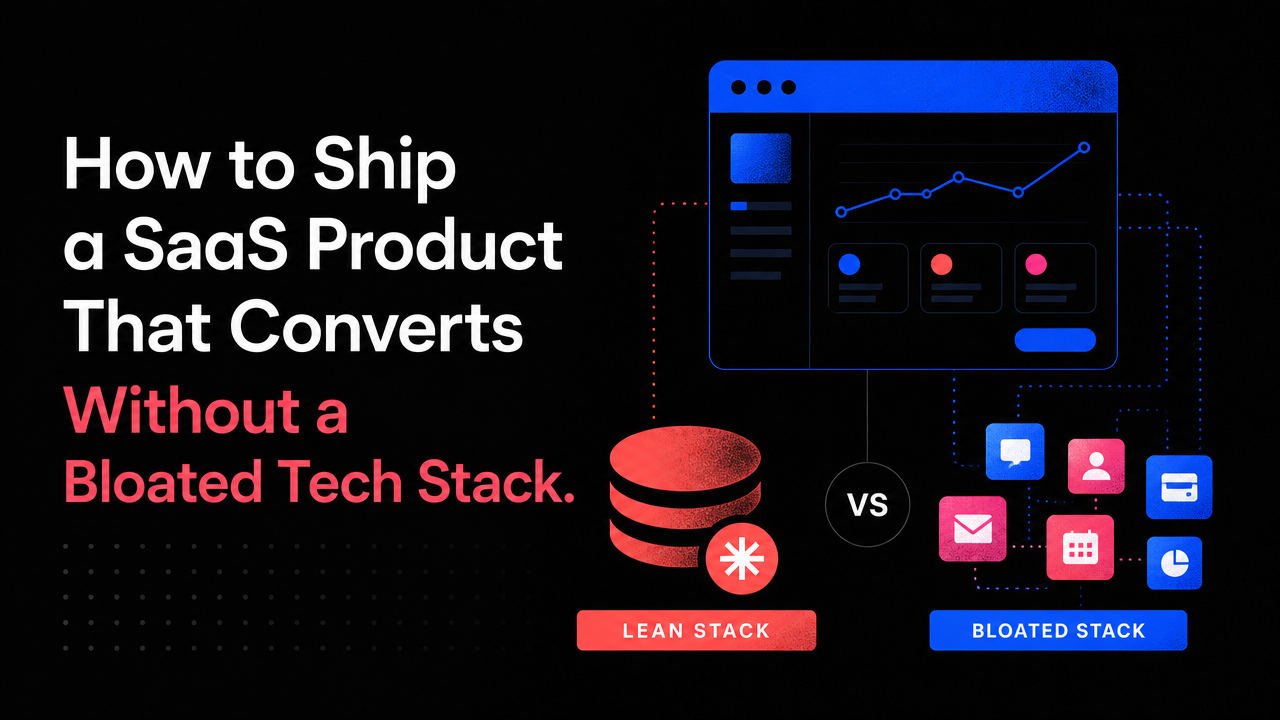
The fragmentation trap: why your SaaS development stalls
Most early-stage SaaS founders inherit a patchwork of vendors before they ship their first feature. A designer here, a freelancer there, a contractor for the backend—and suddenly you're managing five different tools, communication channels, and competing priorities. The result: delays compound, vision drifts, and your product ships months behind schedule with seams still visible in the user experience.
The core problem isn't the number of people involved—it's the cost of translation. Every handoff between design and development, every unclear requirement that surfaces mid-sprint, every time someone misses context because they weren't in the room: each costs time and momentum. For a bootstrapped founder moving toward product-market fit, that friction is often the difference between launching and burning out.
What a unified product development workflow actually requires
A truly cohesive SaaS product doesn't need a 50-person engineering team. It needs three things working in concert: clear visual and interaction design rooted in user needs, development that moves at the pace of those designs without rewrites, and deployment infrastructure that scales before you have to rebuild it.
The mistake most founders make is treating these as sequential stages—design, then build, then ship—instead of parallel disciplines. When design and development align from day one, the product reflects that coherence. The interface is intuitive not by accident but by intent. The backend supports the experience rather than constraining it. And most critically, you iterate faster because there's no translation layer bleeding away your timeline.
This alignment is what separates products that feel polished from products that feel bolted together. A user can sense when design and engineering are in sync; they experience it as simplicity. When they're not, that friction shows up as confusing flows, missing details, or features that don't quite work the way they appear they should.
How no-code tools reshape the timeline
The rise of platforms like Webflow and Framer has fundamentally changed what "quick" means for SaaS. A top Webflow development agency can now ship interactive prototypes, landing pages, and even early product iterations in weeks rather than months—because the tool removes the ceremony of traditional front-end deployment. You don't ship code; you ship experience.
This matters because speed in the pre-product-market-fit stage compounds. Getting feedback from 50 real users in month one instead of month four changes what you learn. It changes whether you pivot before burning capital or after. It changes whether your MVP validates your thesis or forces you to start over.
But no-code alone isn't enough. A beautiful Webflow site that can't connect to your backend, or a polished prototype that doesn't live in your actual product, is a separate artifact—not an acceleration of your real work. The real win happens when your design and development partner uses no-code *as part of a larger strategy*, not as an end in itself. That might mean rapid iteration on the UI in Framer while the backend scales, or using Webflow for your customer-facing site while building the SaaS platform itself with the right technical foundation.
When to consolidate your vendor list
The decision to move from fragmented vendors to a single partner isn't about loyalty or convenience. It's about information density. A partner immersed in your product—who has seen the full design system, understands the platform architecture, knows which decisions were deliberate and which were compromises—can execute the next phase faster and better than a new contractor jumping in cold.
This is especially true for saas website development. Your marketing site and your product are not the same thing, but they are deeply connected. A visitor who lands on a compelling site that doesn't accurately reflect your product's actual experience will churn in the first session. A partner who understands both your positioning and your platform can make sure the promise and the product align.
The early-stage SaaS companies that move fastest are often not the best-funded; they're the ones with the tightest feedback loops. That means fewer decision-makers, clearer requirements, and yes, fewer vendors. It means working with a framer website development company that can iterate on your designs in real time rather than waiting for feedback cycles that span weeks.
What to look for in a development partner
- Experience with B2B SaaS specifically. The design and development challenges in SaaS are distinct—complex user workflows, multi-tenant architecture, compliance considerations, and the need to onboard users into non-obvious products. A partner steeped in this context can anticipate problems and solve them faster.
- Ability to go deep. A partner who understands both sides of the design-development split—who can speak to why a particular interaction pattern is better for conversion and also why it matters for the backend—will ship a more coherent product.
- Comfort with iteration. Your product will change. Your direction might shift. Your assumptions about users will be wrong. The right partner treats these as design challenges, not scope creep.
- Transparency about tradeoffs. Faster shipping often means making deliberate choices about what to build and what to defer. A partner who helps you make those choices explicitly, rather than hiding them, keeps you aligned and moving.
How this compounds as you scale
The payoff of a unified workflow isn't just that you ship faster initially. It's that you've built a foundation that scales. Your design system is documented and enforced because it lived in real code from day one, not retrofitted later. Your architecture makes sense because design informed it early, and you didn't paint yourself into a corner trying to support something impossible to use.
Early customers—the ones most important for product-market fit—don't expect perfection. They expect a coherent experience that solves their real problem. They notice when a product feels intentional. And when you've built it with design and development in true partnership, from the first pixel to the first deployment, that intentionality is unmistakable.
The path forward
Consolidating your approach isn't about hiring one agency and hoping for the best. It's about finding a partner whose constraints and strengths align with yours—someone built to work with early-stage founders, who understands the B2B SaaS space deeply, and who can move at the pace you need. The Small Square specializes in exactly this: comprehensive design and development services for early-stage SaaS companies with small teams and big ambitions. By bundling design, web development, and platform architecture into a single workflow, you eliminate the translation tax and ship products that feel complete.
The best time to consolidate your vendor list is before you're stuck with a mess. The second-best time is now.



Accepted Payments

