How to Know When Your SaaS Needs a Design Agency vs. a Full-Stack Developer
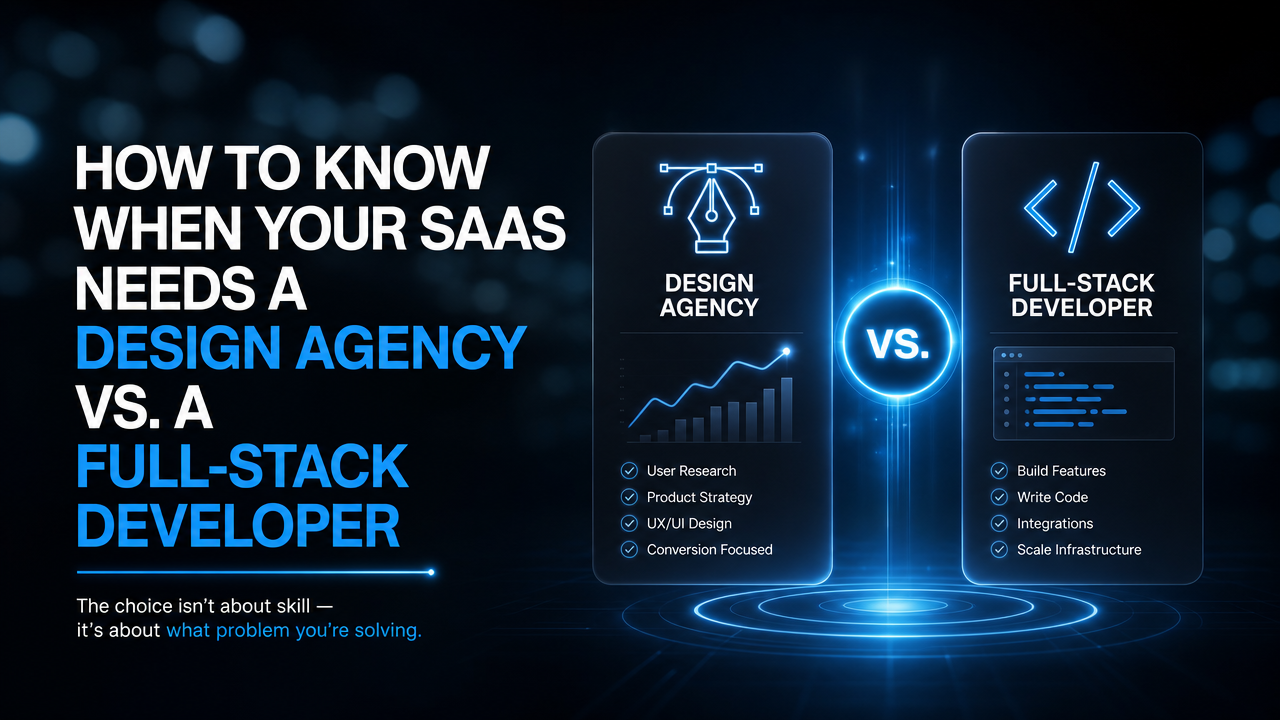
The choice isn't about skill — it's about what problem you're actually solving
Most early-stage SaaS founders ask the wrong question. They compare a design agency to a full-stack developer as if they're interchangeable. They're not. A developer builds functionality. A design agency builds products that people want to use and pay for. The distinction matters because it determines whether you ship something that works or something that sells.
The real question isn't "Should I hire a designer or a developer?" It's "What's blocking my growth right now — the ability to build, or the ability to make what I build compelling enough to convert?"
What a full-stack developer actually delivers
A full-stack developer's job is to turn specifications into working code. They handle the backend (APIs, databases, authentication, payments), the frontend (React, Vue, or similar), and deployment. They solve technical problems: scaling the database, integrating a payment processor, building role-based access control, optimizing performance.
If your product already has clear requirements — "we need a dashboard that shows user metrics" or "we need an API that syncs data every 5 minutes" — a developer can execute that. They work from a brief. They ship features. They fix bugs.
The limitation appears the moment the brief itself is fuzzy, or the brief is clear but users don't want what you built. A developer can't tell you whether your dashboard layout will confuse users. They can't diagnose why prospects sign up but never activate. They can't redesign your onboarding to fix a 60% drop-off on day three. Those are design problems, not engineering problems.
What a design agency delivers (and why it's different)
A SaaS design agency does something subtly but fundamentally different. We start by understanding the user's job, the market pressure your founder faces, and the moment of truth where a prospect either becomes a paying customer or bounces to a competitor. Then we design the product experience around that.
Good SaaS product design is opinionated. It says: "Your users don't need that feature — they need this workflow." It challenges the brief. It surfaces assumptions hidden in your roadmap. It designs for both the initial wow moment and the 90-day retention problem that kills most SaaS companies.
We deliver artifacts: wireframes, design systems, interactive prototypes, component specifications, and—critically—a rationale for every decision so your developer team understands not just what to build, but why it matters. When that handoff is clean, developers build faster because they're not guessing.
A design agency also owns the whole product surface: the marketing site, the onboarding flow, the dashboard, the mobile app, the billing page. We design for coherence. A developer typically owns one piece—the app—and has less visibility into whether the landing page promise aligns with the actual product experience.
When you need a full-stack developer first
Hire a developer if:
- You have a functioning prototype or MVP and users are already using it. You're past the "does anyone want this?" stage. Now you need to scale the infrastructure, add features users are asking for, and fix performance issues.
- Your product is primarily infrastructure or backend-heavy. A DevOps tool, a data pipeline, an API—these are engineering problems first. The interface matters, but the hard part is the systems underneath.
- You have a detailed specification and clear user feedback. You know exactly what to build and why. You just need someone to code it.
- You're post-product-market fit and scaling a team. You need developers more than you need designers at this stage. The product direction is set. You're hiring to handle volume and complexity.
Developers are also the right hire if you're bootstrapped and have limited budget. A good developer costs $80K–$150K annually (or $40–$100/hour for contract work). They deliver working software. You can iterate in code and learn from real user behavior.
When you need a design agency first
Hire an agency if:
- Your product idea is clear, but you're not sure how to package it. You know the problem you're solving, but not the workflow. You haven't validated whether users will understand your value prop on landing. A design agency runs discovery, tests assumptions, and designs the product experience before you spend $200K building it wrong.
- You're comparing yourself to a crowded market and losing. Your feature set is fine, but your product looks generic. Users don't feel the difference. Design agencies specialize in creating products that feel distinctive and premium—products that "sell themselves" because the experience is the differentiator.
- Conversion or retention is stuck despite having traffic. Your landing page gets clicks. Your demo signup rate is okay. But 50% of users churn on day seven. That's a design problem. It means the onboarding doesn't set expectations correctly, or the core workflow is confusing, or the value isn't visible until day 15. A developer can't fix that. A design agency can.
- You're fundraising and need to de-risk the product story. Investors want to see that you've thought deeply about user experience, competitive positioning, and how the product will scale. A polished, coherent product design (with a clear narrative) signals founder discipline and market awareness.
- You're in a technical market (DevOps, infrastructure, security) where the buyer is also an engineer. This is where domain expertise becomes critical. A designer who has actually shipped in DevOps—who understands incident response, observability, RBAC, and the workflows of ops teams—will design something that feels native to that world. A designer who has only done fintech or e-commerce will miss the details that make ops engineers trust your product. This is why The Small Square's background at Mattermost and Focalboard matters: we don't design DevOps products as guesses. We design them as people who've lived in that space.
The real cost equation
A full-stack developer costs roughly $10K–$20K per month (freelance or early hire). A design agency engagement for a serious SaaS product typically ranges from $30K–$80K for comprehensive product design and marketing site work.
That sounds more expensive, but context matters. If you hire a developer to build a product that no one wants, you've wasted three months and $30K–$60K of salary. If you hire a design agency to clarify the product before you build it, and that clarity prevents you from building the wrong thing, you've saved money and time.
The inverse is also true: if you know exactly what you need to build and have strong user feedback already, hiring a designer is wasteful. Pay a developer to execute.
The best founders do both—but in sequence
The pattern we see with successful early-stage SaaS founders is this:
- Hire a design agency first (or co-found with one). Spend 4–6 weeks on discovery, strategy, and detailed product design. Validate your narrative with the target market. Build interactive prototypes and test assumptions before writing a line of production code.
- Hand off to developers. Give your dev team (or hire contractors) the design system, specifications, and wireframes. Let them build the actual product. This is where your SaaS development services partner comes in—whether you're using a top webflow development agency for your marketing site or a saas development services company for your product infrastructure.
- Iterate based on real user feedback. Once live, use real behavior to inform design and engineering decisions. Developers can ship small features. Designers refine based on data.
This sequence works because design shapes engineering. If you reverse it—hire developers first, then hand them off to a designer to "make it pretty"—you'll end up redesigning the backend to support the UX, which is expensive and demoralizing.
How to make the decision
Ask yourself honestly:
- Do I know who my user is and what problem I'm solving? Yes → you can hire a developer. No → hire a design agency first.
- Have users tested my product and given me detailed feedback on the workflow? Yes → developer. No → design agency.
- Am I losing deals because the product experience is confusing or generic? Yes → design agency. No → developer.
- Is the hard part technical (infrastructure, scaling, integrations) or experiential (making users want to use it)? Technical → developer. Experiential → design agency.
One more test: if you're in a domain-specific market like DevOps, infrastructure, or security, and your competitor's product feels like it was designed by people who actually use that product daily, you need a partner with that credibility. A generalist developer can't compete on that signal. Neither can a designer who learned SaaS UX patterns in a course. You need a team that has shipped in your industry.
The pattern we see most often
Early-stage SaaS founders typically underestimate design and overestimate their ability to hire developers. They think "I'll build an MVP, ship it, and iterate." What actually happens: they ship something technically sound that no one uses, or users churn because the experience is confusing. Then they hire a designer to "fix it," which means rebuilding. That's expensive and slow.
The founders who move fast are the ones who design first, build second, and learn from real users third. It feels slower upfront because you're spending a month on design instead of jumping to code. But you ship the right product the first time, which is faster overall.
Getting started
If you decide a design agency is the right move, look for one with concrete proof: shipped products, domain expertise in your space, and a portfolio that shows not just pretty work but products that actually grew. If you're building a DevOps tool, a designer who has worked on consumer apps won't understand your users' mental models. That's not a skill gap—it's a foundation gap.
The Small Square has built 25+ B2B SaaS products with over 14 years behind shipped products like Mattermost and Focalboard. We specialize in the exact scenario where founders are caught between "build fast" and "build right." Our design process surfaces the assumptions you didn't know you were making, which saves time and money downstream. We also handle your full product surface—from the landing page to the dashboard to the onboarding—so everything tells the same story. If you're at the stage where you need clarity before code, schedule a free strategy call and we'll help you see whether design or development is your real bottleneck.
For marketing sites and web presence, we work across platforms depending on your needs: as a framer development company for interactive, conversion-focused sites, and as a top webflow development agency for complex, CMS-driven projects. And if you need the full product built after design, we connect you with the right saas development services company to execute.



Accepted Payments

