How to Choose Between No-Code and Custom Development for Your B2B SaaS Product
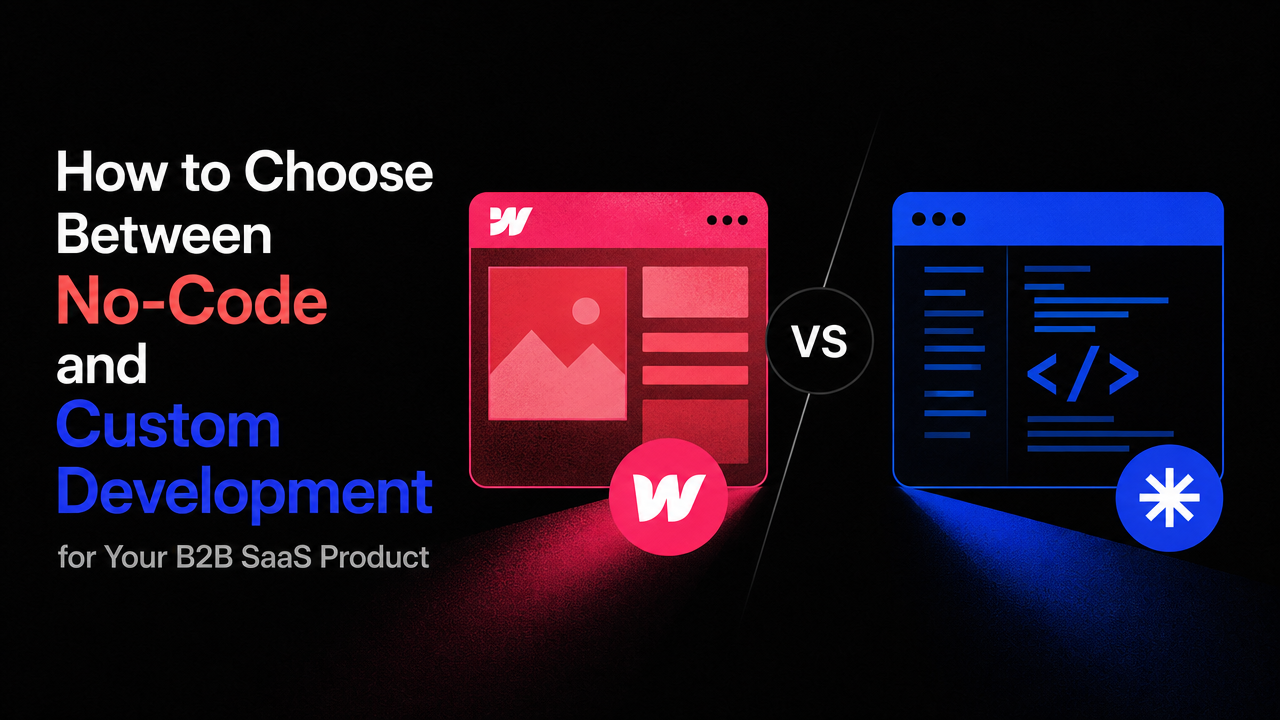
No-code and custom development solve different problems at different stages of a SaaS company.
When you're building a B2B SaaS product as an early-stage founder, the choice between no-code tools and custom development isn't binary—it's contextual. No-code platforms like Webflow and Framer excel at speed and iteration, while custom development provides flexibility and scalability as your product matures. The decision comes down to your timeline, team capacity, and what specific part of your product you're building.
When No-Code Wins
No-code tools shine when speed matters more than perfect customization. Marketing websites, landing pages, and internal dashboards can often launch faster with no-code than waiting for developers to write boilerplate. If you're an early-stage founder with a tight timeline—say, you need to validate a product concept or ship a landing page in weeks, not months—a webflow development agency can compress your development cycle significantly.
No-code also works well when design and development need to move together. Rather than passing specs between teams, a no-code-first approach keeps designers and developers in the same tool, cutting back-and-forth and reducing misinterpretation. For early-stage teams under 20 people juggling multiple responsibilities, this alignment matters.
Another clear win for no-code: cost. Custom development for a polished marketing site or user dashboard can run $30K–$100K+. A no-code alternative often delivers 80% of the visual fidelity for a fraction of that. If budget constraints are real—which they usually are pre-product-market fit—no-code lets you stretch resources.
When Custom Development Becomes Essential
Custom development enters the picture when your product has specific logic, performance demands, or integrations that no-code platforms can't handle cleanly. If your B2B SaaS requires real-time data syncing, complex workflows, API integrations with third-party tools, or compliance requirements (HIPAA, SOC 2), you'll outgrow no-code constraints quickly.
Performance also matters. No-code platforms handle typical web traffic, but a saas website development solution built in custom code gives you finer control over response times, database queries, and scaling. If your product is computationally heavy or needs to serve thousands of concurrent users, custom development is the only realistic path.
Scalability is another inflection point. No-code tools have limits—database capacity, API rate limits, and architectural constraints. Custom development lets you build once and scale to 10,000 users, then 100,000, without rebuilding the core product. Early-stage SaaS founders often misjudge how quickly this matters; by the time you're hitting product-market fit, a no-code foundation can become a bottleneck.
The Hybrid Approach: No-Code and Custom Together
The strongest path for many early-stage SaaS companies blends both. Use no-code for customer-facing marketing, onboarding flows, and dashboards where visual consistency and rapid updates matter. Pair that with custom development for your core product platform—the backend logic, data model, and API layer that drives the business.
A framer website development company can ship a polished, animated marketing site in weeks. Meanwhile, your backend team builds the SaaS platform itself in a scalable framework. This approach lets you launch fast, validate assumptions, and keep customers engaged while the real product hardens underneath.
This hybrid model also reduces risk. Your marketing presence isn't coupled to your product infrastructure. If you need to rebuild the platform later, your public-facing site and onboarding flow stay stable. Conversely, if your landing page needs redesign, your product team isn't blocked.
Key Questions to Ask Before Choosing
Timeline pressure: Do you need to launch something in under 12 weeks? No-code accelerates this. Are you 6+ months away from launch? Custom development becomes viable.
Complexity: Does your product require custom logic, integrations, or real-time data? If yes, lean custom. If it's mostly presentation and form handling, no-code often suffices.
Scaling expectations: Are you planning to grow to thousands of users? Custom development scales more predictably. If you're validating a hypothesis first, no-code de-risks the investment.
Team capacity: Do you have developers, or are you founder-led? No-code empowers non-technical founders to ship. Custom development requires specialized skill or budget for contractors.
Integration needs: Will your product connect to Salesforce, HubSpot, Stripe, or proprietary APIs? Custom development gives you more control. Some no-code platforms support integrations, but custom code is more flexible.
A Realistic Timeline for Each Path
No-code marketing site: 4–8 weeks. A fully designed, animated landing page or company website with no custom code.
No-code internal tool or dashboard: 6–12 weeks. A functional, data-driven interface for team workflows.
Custom SaaS platform MVP: 8–16 weeks. A functional core product with basic authentication, data persistence, and one or two key features. This assumes a dedicated development team or agency.
Scaled custom platform: 3–6 months. A production-ready SaaS product with performance optimization, security hardening, and multiple features.
Conclusion: It's Not Either/Or
The decision between no-code and custom development isn't a one-time choice—it's a progression. Most successful early-stage SaaS companies start with no-code for speed and visibility, then shift to custom development as complexity and scale demands increase. The Small Square specializes in this exact transition, offering both rapid no-code deployment and full custom SaaS platform development under one roof. This continuity means you don't have to re-architect or rebuild as your product grows; the same partner can evolve your stack alongside your business. Choose no-code for speed and validation. Choose custom development for scalability and control. Choose both when you want to move fast and build something that lasts.



Accepted Payments


