How to Build a SaaS Product That Sells Itself: Design Strategy Over Marketing Spend
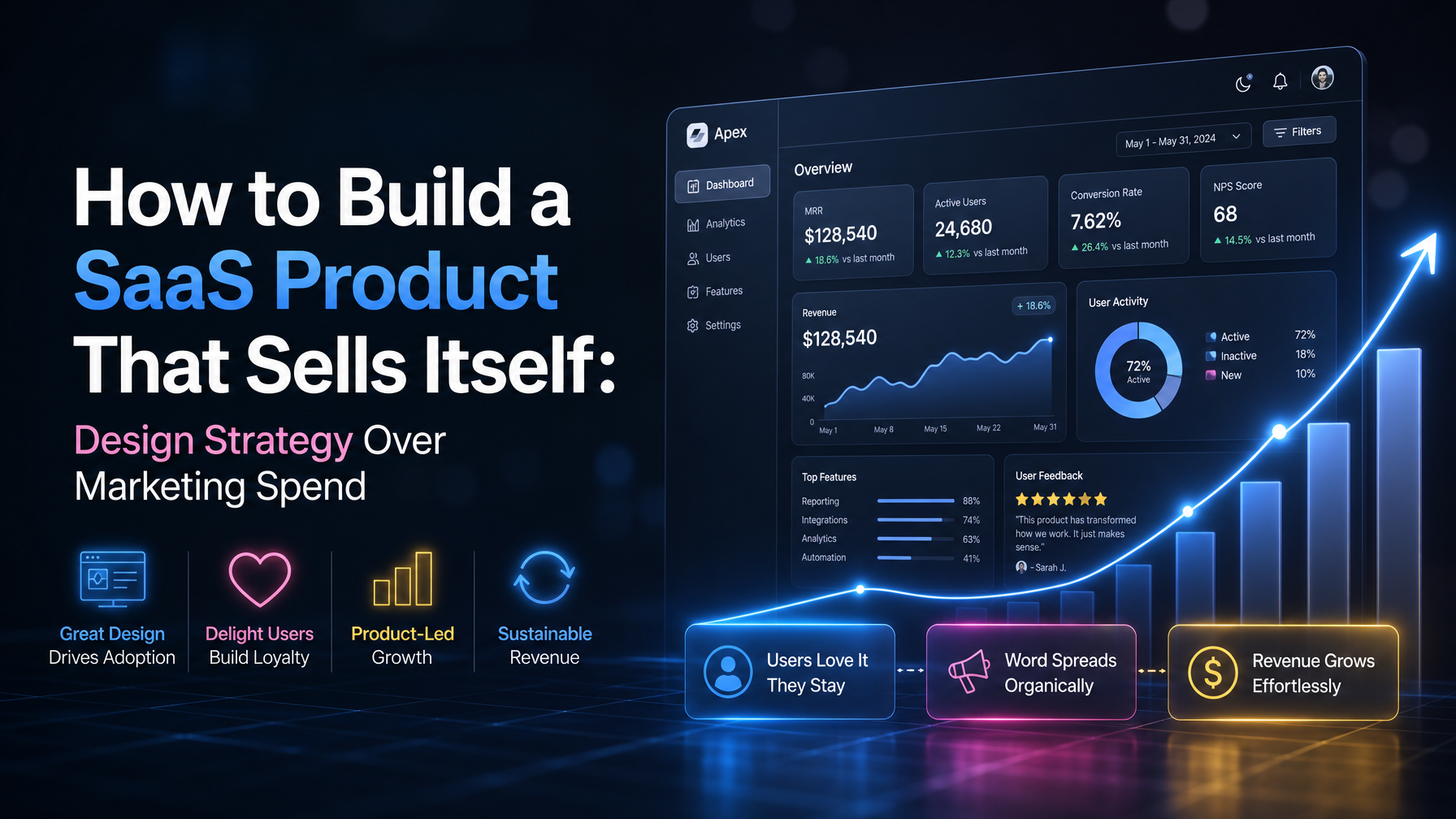
Most SaaS founders spend money on marketing when they should be spending it on design.
The assumption is backwards: marketing amplifies a weak product's message, while great design makes the product speak for itself. A SaaS product that sells itself doesn't need constant acquisition spend because its core interaction loop, onboarding, and value clarity do the selling. The difference isn't subtle—it shows in CAC, retention, and whether users evangelize or tolerate your product.
The Small Square has shipped products across branding, web design, mobile development, and SaaS platforms. The pattern is consistent: founders who win aren't the ones with the biggest marketing budgets. They're the ones whose products solve a specific problem so clearly that the first-time user experience confirms they made the right choice immediately.
What "Sells Itself" Actually Means
A product that sells itself is one where the user's first interaction proves the value proposition without friction, explanation, or guesswork. This isn't magic—it's deliberate design across four specific areas: positioning clarity, onboarding flow, feature discoverability, and conversion mechanics.
1. Positioning Clarity: One Clear Problem, One Clear Answer
Vague positioning forces users to translate your product into their own language. Specific positioning answers the question before it's asked: "What is this, and is it for me?"
Compare these two positioning statements:
- "Workflow management for modern teams" (unclear, could be Slack, Asana, or Notion)
- "Incident response coordination for on-call engineers—run playbooks, resolve faster, close postmortems in one place" (Mattermost-specific, answers the job to be done)
When The Small Square designed UX/UI for Mattermost's playbook features, the clarity came first. Users landing on that product know instantly whether they manage incidents or coordinate general workflows. Fewer confused users means fewer wasted onboardings and higher conversion from trial to paid.
Positioning clarity shows up in your headline, hero section, and the first three interactions. A user should never wonder what your product does.
2. Onboarding as the First Sale
Onboarding is where a self-selling product proves itself. Not in a tutorial, but in a real outcome.
The best SaaS onboarding doesn't teach the product—it delivers the first moment of value within minutes. This might look like:
- Uploading data and seeing it organized immediately (not learning the interface first)
- Creating one output without setting up 10 configurations
- Seeing your exact use case solved, not a generic demo
When a user completes onboarding and has actually solved their problem (even at small scale), they believe the product works. They'll pay for more of it. If onboarding is a tutorial maze with no outcome, users churn before they understand the value.
This is why SaaS development services that skip discovery and jump to builds fail. The developer needs to understand not just the feature set, but the user's mental model and the exact outcome that proves value. That informs every interaction design choice.
3. Feature Discoverability Without Clutter
Self-selling products don't hide power features—they surface them at the moment a user needs them, not in an admin settings menu.
Take dashboard design. A common mistake is building a dashboard that shows all available data and features at once. Users are paralyzed by options. A self-selling dashboard shows only what matters for the current task, then hints at the next capability when the user is ready for it.
This requires:
- User role-based views (a manager sees what managers need; an analyst sees what analysts need)
- Progressive disclosure (advanced options hidden until the user's workflow requires them)
- Contextual help at the moment of action (not a separate help section)
The design system and frontend architecture need to support this. A static, monolithic design system can't adapt interfaces to different user contexts. This is why scalable webflow development agency partners and modern component-driven architecture matter—they let you build once and adapt across roles and workflows without duplication.
4. Conversion Mechanics That Feel Natural
A product that sells itself doesn't hard-sell. It guides.
The conversion moments in a self-selling product are:
- Trial-to-paid: The user has already solved their problem in trial; paying is just removing the limitation.
- Free-to-upgraded: The user hits a ceiling (file limits, user seats, API calls) and upgrading is the obvious next step because they're already getting value.
- User referral: The user benefits so much that they mention it to a peer without being asked.
These moments work when there's genuine value flowing before the ask. If a user is paying because of a paywall, not because they're addicted to the outcome, you're not selling a product—you're forcing a transaction.
How Design Strategy Differs From Marketing Strategy
Marketing strategy is about reach, messaging, and channel choice. It assumes the product is fixed and the job is to find the right audience or refine the pitch.
Design strategy assumes the product itself is the message. It focuses on:
- Clarity of the core interaction: Can a new user complete the primary task without help?
- Velocity to value: How fast does the user see a real outcome?
- Evidence of effectiveness: Does the product visibly show that it worked?
When The Small Square works with early-stage SaaS founders, the conversation starts here. Not "How do we market this?" but "Does the product itself prove its value in the first session?"
If it doesn't, no amount of paid ads will fix it. Users will click your ad, onboard, feel confused, and churn. Your CAC gets worse every month.
If it does, organic signups compound. Users tell peers. Your support load stays manageable because fewer people are confused about what the product does.
The Mechanics: What This Looks Like in Practice
Example: SaaS Dashboard Design
A common SaaS onboarding flow that sells itself:
- User lands with one headline, one CTA, no noise.
- They sign up and hit an empty state (no data yet).
- The empty state is not a tutorial—it's a data import flow. They upload their spreadsheet or connect their API in 90 seconds.
- They immediately see their data organized in the dashboard with the exact metrics they care about. No configuration. The dashboard guesses correctly because the design team researched their workflow first.
- They try one action (filter, export, run a report) and it works instantly.
- They're sold. The onboarding took 5 minutes, and they did something real.
This requires product design that understands the user's mental model and UX/UI engineering that can deliver it reliably. It's not a marketing message; it's a system design choice. And it's why saas development services matter—the backend, API, and frontend all need to orchestrate that first moment of value perfectly.
Example: Landing Page That Positions, Not Pitches
A landing page that sells itself doesn't open with "We make software for teams." It opens with the specific problem and the specific solution:
"You deployed code at 3 AM. The site went down. Your incident response system is Slack, emails, and a spreadsheet. You spend 20 minutes finding the right people, then 40 minutes fighting the outage, then 2 hours writing a postmortem that no one reads. We cut that to 10 minutes, 30 minutes, and 15 minutes."
That positioning is only possible if you deeply understand the user's current workflow and the pain it creates. Then the landing page shows a real screenshot of your product solving that exact workflow—not a polished mockup of features, but a concrete proof.
Design agencies like The Small Square build landing pages with this positioning-first approach. The design is clean and modern, but the substance is the clarity. Users land, recognize their problem, and see the solution. The CTA is almost redundant.
Building for Self-Selling: The Framework
If you're building a SaaS product, here's the design strategy checklist:
Before You Build
- Define one clear problem and one clear audience. (Not "for all teams," but "for on-call engineers.")
- Map the user's current workflow (what they do today, how long it takes, what breaks).
- Define the moment of value (the exact outcome that proves your product works).
- Plan the shortest path from signup to that moment of value.
During Design
- Design the onboarding flow first, before the full product. Does a new user reach the value moment in under 10 minutes?
- Build your information architecture around the user's tasks, not your feature list.
- Design for role-based views (different users see different dashboards).
- Plan progressive disclosure (show only what's needed for the current task).
During Development
- Build the backend API to support the onboarding flow first. (Not "all features," just the ones new users need.)
- Invest in responsive design and performance. Slow products don't sell themselves; they frustrate.
- Plan for custom framer website development or webflow development agency partners if your landing page and product marketing site need to convey that positioning clarity with visual precision.
- Make data import/setup fast and obvious. If users have to configure 50 settings before they see value, they'll churn.
After Launch
- Measure the time to first value (how long from signup to completing the primary task).
- Track onboarding completion rates (what percentage of users reach the value moment).
- Monitor organic signups and referral rate. These are the true measures of a self-selling product.
- Test removal of features. If no one uses a feature after six months, it's adding cognitive load without value. Remove it.
Why This Matters for Early-Stage Founders
When you're bootstrapped or raising a seed round, you can't afford to waste money on marketing that's repairing for poor product design. Every dollar matters. Building a product that sells itself means:
- Lower CAC: Users arrive through word-of-mouth, not ads.
- Higher retention: Users who reach the value moment stay and upgrade.
- Easier fundraising: VCs see organic growth and high engagement. That's proof of product-market fit, not impressive ads.
- Sustainable growth: You're not chasing cohorts; you're compounding happy users.
The founders who win aren't the ones with the best pitch decks or the biggest marketing budgets. They're the ones whose products work so well that the first user tells five peers, and those five tell twenty more.
That's not luck. That's design discipline.



Accepted Payments

