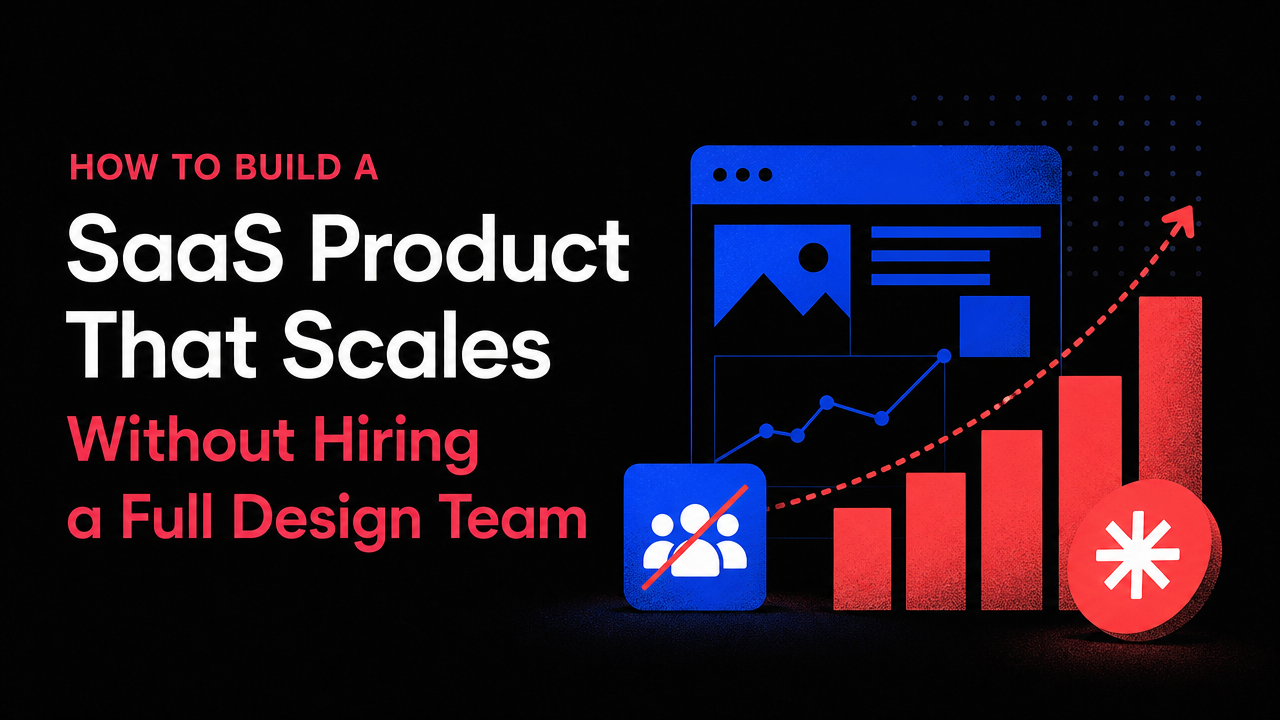
How to Build a SaaS Product That Scales Without Hiring a Full Design Team
The SaaS Scaling Problem Most Founders Don't See Coming
Early-stage SaaS founders face a paradox: you need design expertise to compete, but hiring a full in-house design team is a luxury you cannot afford. A senior designer costs $120–150K annually, plus benefits, equipment, and onboarding time. Add a junior designer and a design ops person, and you are looking at $300K+ before shipping a single feature. Most teams under 20 employees cannot justify that spend when cash runway is measured in months.
The result? Founders either ship products with surface-level design work, or they delay launch while trying to recruit. Both paths cost time and momentum—two resources early-stage teams have in short supply.
What Happens When Design and Development Are Truly Aligned
The difference between a product that converts and one that merely launches often comes down to a single factor: design and development moving in sync from day one. When a designer works in isolation from engineers, handoff friction multiplies. Design systems get misinterpreted. Interactions break. Time-to-market stretches. When they work together, the product feels intentional, responsive, and worth paying for.
This alignment is exactly what you get when you partner with a firm that treats design and development as a single discipline, not two separate functions. The Small Square builds this cohesion into how it works—designers and developers collaborate from the initial brief through deployment, so your vision translates into a product that actually sells.
Why Speed Matters More Than Perfection at Your Stage
You are not competing against Google or Figma. You are competing against the status quo: your customer's current manual process, spreadsheet, or existing tool that "works fine but is slow." To win, you do not need a perfect product—you need one that solves the problem 30% better than the alternative and launches before your runway burns.
This is where no-code and rapid-iteration tools become strategic advantages. A webflow development agency can ship a high-converting landing page and web product in weeks, not months. A framer website development company can prototype complex interactions and hand off production-ready code without the typical design-to-dev cycle eating weeks of elapsed time.
For early-stage SaaS, this speed is not a feature—it is survival. You need to test assumptions with real users while your funding and team morale hold.
The Fragmentation Trap: Why a Tool Stack Is Not the Same as a Team
Many founders attempt to stitch together a distributed team: a freelance designer on Upwork, a developer from Toptal, a landing page builder subscription, and a no-code platform of the week. On paper, this looks cheaper. In reality, it is a tax on focus.
Coordination overhead explodes. Who owns the design system? What happens when the designer's vision requires custom code, but the developer is not incentivized to build for reuse? When the onboarding flow breaks at the seam between the landing page platform and the app itself, who is responsible for fixing it?
A unified partner eliminates this friction. One team, one vision, one responsibility for the entire product journey from first impression to core experience.
How a Partner Replaces the Need for Multiple Hires
Working with a saas website development partner that covers design, web development, and mobile app development means you avoid hiring separately for each discipline. You do not need to recruit a design lead for the website, a separate mobile app designer, and backend engineers. Instead, you get a team with 14+ years of B2B SaaS product experience—people who have seen what works and what does not.
This approach also sidesteps the hiring timeline problem. Recruiting a designer takes 2–3 months. Recruiting someone great takes 4–6. Your product timeline cannot wait. A partner you can start working with this week is worth more than a perfect hire you will have in Q3.
What to Look For in a Design and Development Partner
Not all agencies are built for early-stage SaaS. Many are optimized for large budgets and long timelines. The right partner has these traits:
- SaaS-specific experience: They understand B2B buying cycles, onboarding friction, feature prioritization, and the difference between a feature that looks good and one that actually drives retention.
- Speed and iteration: They use tools and methodologies that let them ship fast and adjust based on feedback, not processes designed for Fortune 500 waterfall projects.
- Comprehensive services: They handle design, web development, and mobile—so you do not have to coordinate across multiple vendors and manage their handoffs.
- Proven track record with teams your size: They have scaled products for other founders, not just managed enterprise rebrand projects.
The Real Cost of Not Having This Alignment
Consider the alternative: you hire a designer who designs in isolation, then hands off specs to a developer who builds differently than intended. Three months in, you realize the product does not match the brief, and you have already spent the budget. Or you use a templated SaaS builder, ship quickly, but hit a wall when you need to customize the experience. Now you are rebuilding.
The cost is not just money—it is momentum. Every delay, every rework, every coordination failure pushes you further from product-market fit.
Build the Product Your Early Stage Deserves
You do not need to hire a full design team. You need a partner who can move at startup speed, think like a founder, and deliver a product that sells itself. The Small Square specializes in exactly this—building high-performance, scalable digital products for early-stage SaaS teams that are ready to ship fast and iterate based on real user feedback.
Start with a product that works. Growth and polish can follow. Speed and alignment cannot be bought later.



Accepted Payments

