How Product Design and Development Cycles Differ for B2B SaaS Versus Consumer Apps
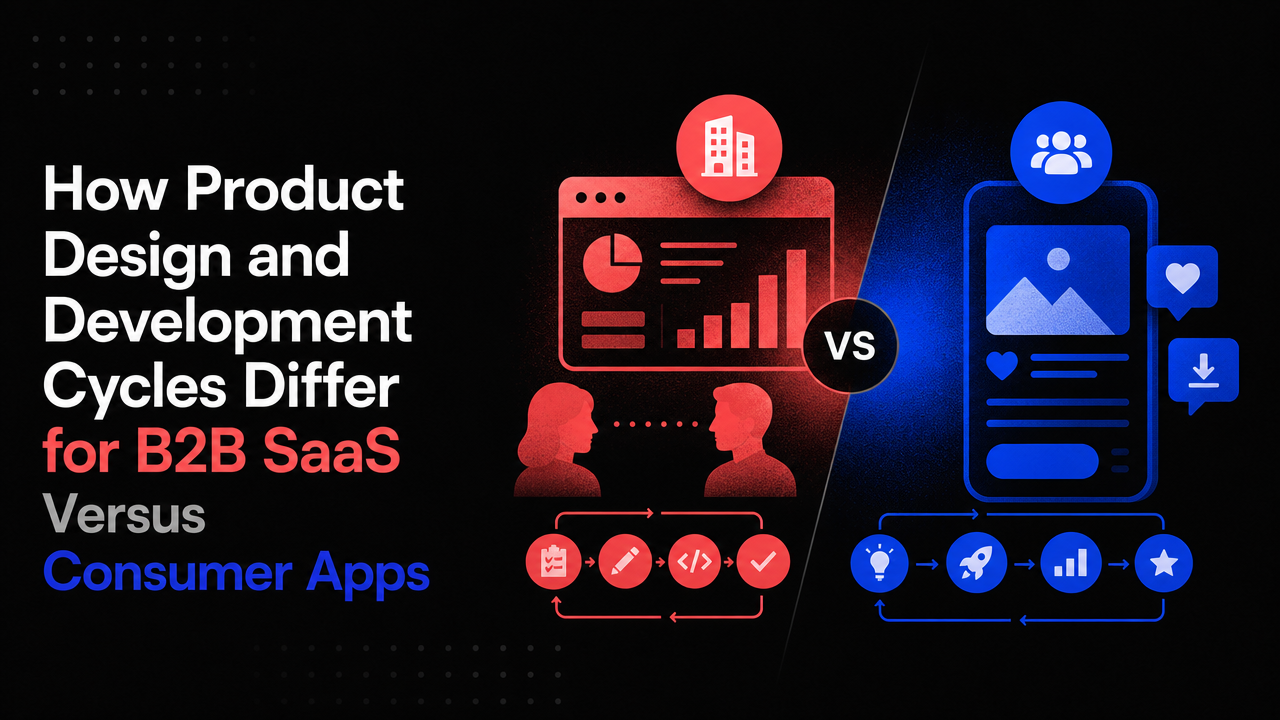
B2B and consumer products follow different playbooks—and their design cycles prove it.
A B2B SaaS founder building for enterprises faces a completely different set of constraints than a consumer app founder optimizing for virality. The person who decides to buy your product is often not the person who uses it every day. The purchase cycle takes months, not minutes. The design conversation centers on workflows, compliance, and measurable return on investment, not delightful micro-interactions. Understanding these differences shapes everything: how long your MVP takes to build, which features to prototype first, and how you validate whether your product actually solves a paying customer's problem.
The B2B SaaS Design Cycle Prioritizes Buyer and User Workflows
In B2B SaaS, design serves two masters simultaneously: the person signing the contract (the buyer) and the people using your software daily (the users). These are rarely the same.
A buyer evaluates based on business outcomes: Does this solve our specific workflow? Will it reduce costs, save time, or improve team coordination? They need documentation, security certifications, integration capabilities, and proof that the product handles their edge cases. They want to see role-based access, audit logs, and admin controls—features that users often never touch.
Meanwhile, the user needs the interface to be intuitive and fast. They're doing their job, not learning software. If your dashboard requires five clicks to perform a daily task, they'll complain to the buyer, and the deal stalls.
This dual design reality extends your validation cycle. Before you can call an MVP complete, you need to test with both personas. Early-stage SaaS founders typically spend weeks refining workflows with power users, then weeks more ensuring the buyer sees ROI in demo scenarios. A consumer app, by contrast, can iterate rapidly with a single user base and watch engagement metrics in real time.
Consumer App Design Cycles Optimize for Engagement and Retention
Consumer products are built around a different metric: engagement. How often do users open the app? How long do they stay? Do they come back tomorrow?
This leads to faster design cycles. You launch a feature, measure engagement within days, and iterate. A/B testing is standard. You can afford to experiment with UI polish, gamification, notifications, and feed algorithms because the feedback loop is immediate and quantitative.
There's also typically one user archetype to optimize for, which simplifies design. You don't need to worry about enterprise integrations, SSO, or compliance frameworks. Your design surface is smaller, and decisions move faster.
The consumer design cycle is also more forgiving of rough MVPs. Users tolerate imperfection if the core value is there. Reddit's early interface was famously plain; TikTok's algorithm mattered far more than pixel-perfect design. B2B SaaS founders rarely get that latitude—a rough interface signals risk to enterprise buyers.
Design Debt Accumulates Faster in B2B Without a Cohesive Partner
Because B2B SaaS design must balance so many competing demands, it's easy to pile on features without a unified strategy. You add a role for compliance. Then an admin panel for the buyer. Then a bulk-action feature for power users. Six months in, your product looks like a patchwork of disconnected tools.
A strong design and development partner matters here in ways it often doesn't for consumer apps. Early-stage SaaS founders with teams under 20 people rarely have the luxury of a dedicated design system owner or a front-end architect who can police consistency. When you work with a SaaS development partner that understands both design and engineering, they can enforce structure from the start: a shared component library, consistent navigation, unified visual language. This prevents the $50K design-debt crisis that strikes later.
Consumer apps can often get away with rapid, scrappy design because the interface is simpler. But B2B SaaS products that look scattered lose buyer confidence before the first contract conversation happens.
Validation Timelines Are Dramatically Different
Consumer apps validate product-market fit through viral loops and retention curves. You need thousands of users to see a pattern. This happens in weeks or months.
B2B SaaS validation is slower but clearer. You need to land paying customers. A single enterprise customer's multi-month sales cycle and detailed requirements teach you more about product-market fit than a thousand free signups. But this means your MVP timeline stretches longer. You're not just building—you're building to a buyer's spec, sometimes before you fully understand the market.
This is why many B2B SaaS founders work with experienced design and development teams from day one. A webflow development agency or framer website development company can accelerate your validation by building interactive prototypes quickly, letting you test ideas with prospects before you commit to full development. Consumer founders often bootstrap an MVP alone; B2B SaaS founders frequently can't afford to.
Platform Architecture Decisions Reflect Different Growth Paths
Consumer apps often start as web-first or mobile-first. You choose one platform, optimize it, and expand later if you hit scale.
B2B SaaS typically requires both from the start. Buyers expect to access critical workflows on desktop and mobile. They want their team to check status from a phone but do real work on a laptop. This forces you to think about cross-platform consistency earlier, and it complicates your design cycle. You can't optimize one platform and ignore the other.
For founders with limited budgets, this creates a real constraint. Building web and mobile separately can double your cost. Working with a partner who specializes in cohesive multi-platform B2B SaaS design—someone who can handle both frontend and backend integration—helps you avoid that trap.
When to Optimize Each Way
Consumer apps should move fast, measure engagement relentlessly, and be willing to launch rough. The market rewards speed and virality over polish.
B2B SaaS founders should invest in design clarity and cross-platform consistency from the start. Your buyer needs confidence that your product is built to scale with them. Rough doesn't work. You're not optimizing for millions of casual users; you're optimizing for a few committed ones who depend on your software to run their business.
The design cycle matters because it shapes your entire company. A consumer app's validation teaches you what hooks users. A B2B SaaS validation teaches you what problems are worth solving for paying customers. Get the cycle wrong, and you'll waste months building for the wrong metric.
Conclusion: Design Cycles Reflect Business Models
B2B SaaS and consumer product design cycles diverge because their business models are fundamentally different. B2B SaaS requires longer validation, dual-persona design, multi-platform consistency, and a focus on measurable business outcomes. Consumer apps need speed, engagement optimization, and viral mechanics.
Understanding this distinction shapes your hiring decisions, your technology choices, and how you measure progress. For early-stage SaaS founders, recognizing that your design cycle will be longer and more complex than a consumer app—and building the right team to handle that complexity—is the difference between shipping a product that sells itself and shipping a product that sits unfinished.



Accepted Payments

