Building a Scalable SaaS Product Without a 50-Person Engineering Team
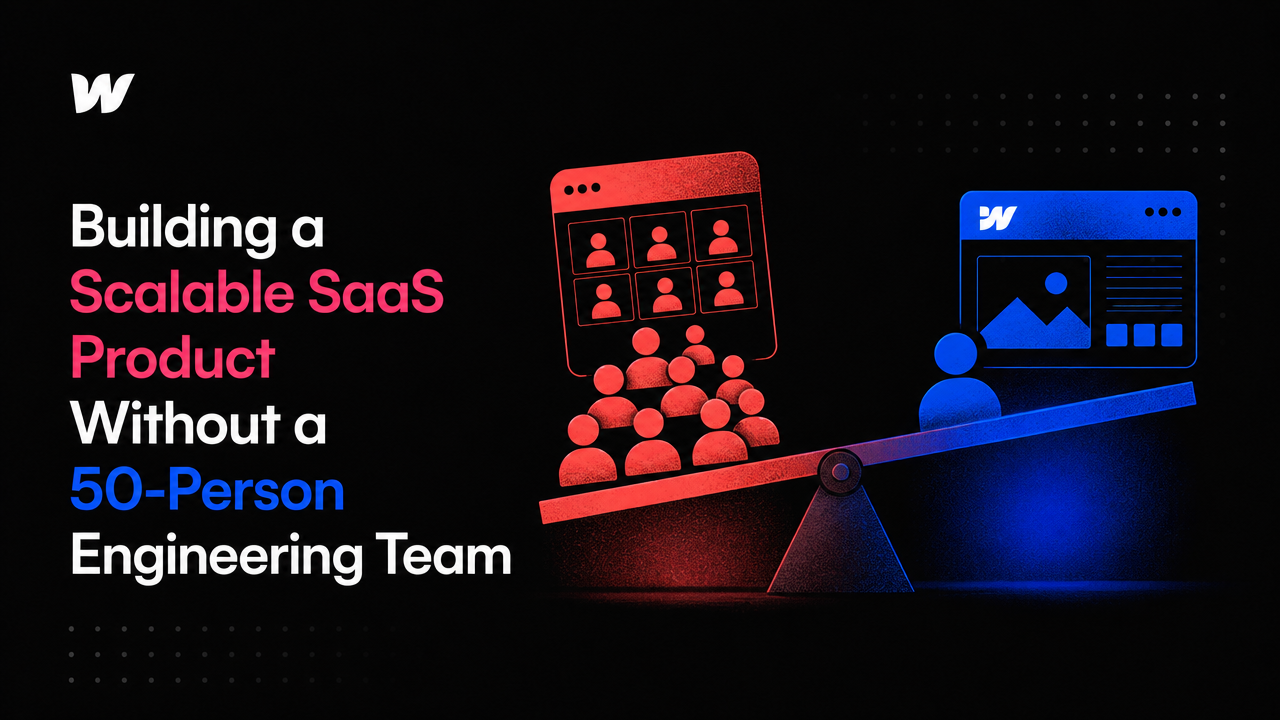
The myth of the big engineering team
Most early-stage SaaS founders assume they need 20+ engineers to build something that scales. They look at Stripe's founding story, or Slack's early growth, and think: that's what scale looks like. But those narratives skip the part where most startups fail not because they lack engineers—they fail because they lack clarity on what to build.
The real problem isn't team size. It's building the wrong product with the wrong architecture, then scaling it expensively.
The design-first shortcut to scalability
Scalability isn't a technical property—it's a design property. Before a single line of production code gets written, your product's scalability is already baked into its architecture, data model, and user workflows. Many founders skip this step, hire a contractor or junior dev, and end up with a product that works for 100 users but chokes at 1,000.
When design and development are split, you get misaligned incentives. The designer optimizes for aesthetics; the developer optimizes for speed. The product ships, and six months later, adding a new feature costs twice as much as it should because the foundation wasn't designed to accommodate it.
A design-led approach forces hard decisions early: How will users invite teammates? How will permissions scale? Where is the single source of truth for data? These questions, answered during design, prevent costly rework later.
No-code tools are not shortcuts—they're architectural choices
Early-stage founders often dismiss no-code platforms as toys, or worse, as a way to avoid "real" development. That's backwards. Tools like Webflow and Framer aren't about cutting corners—they're about applying constraints that force better design decisions.
A webflow development agency doesn't just build websites faster; they leverage a platform designed for performance, security, and hosting from day one. You don't inherit legacy infrastructure debt. You don't maintain servers. You don't pay for uptime you don't use. For a B2B SaaS product in its first 18 months, that's not a limitation—it's a feature.
The same logic applies to custom SaaS development. Before you commit to building a bespoke platform, ask: What constraints would we accept in exchange for shipping 40% faster and reducing our technical debt by half? The answer often reshapes your entire product roadmap.
The small team advantage: clarity over consensus
A team of five to eight people—a founder, a product manager, a designer, two developers—can move faster than a team of 20 because there's nowhere for decisions to hide. When you propose a feature, everyone in the room understands the tradeoff: This takes two weeks and delays that other thing. There's no middle management filtering the signal.
This isn't just faster—it produces better products. Early-stage SaaS companies with under 10 engineering hires often report tighter product focus and faster time to market than companies that scaled to 30+ engineers early. The constraint forces ruthlessness about scope.
The partnership model: access to expertise without the payroll
You don't need to hire a full design and development team. You need access to people who have shipped multiple B2B SaaS products, made the mistakes you're about to make, and know the shortcuts.
A saas website development partner does more than execute. They challenge your assumptions: That dashboard layout looks clean, but users won't find the action button in user testing. Or: Building this feature custom would take six weeks; here's how we do it in four weeks with an off-the-shelf integration. That's the value. Not headcount. Judgment.
For early-stage founders with teams under 20 people, this model replaces the need for expensive agencies (who bill for their overhead) or hiring mid-level developers (who need senior oversight you can't yet afford). You get senior-level decisions at a fraction of the cost.
The architecture that scales with you
Scalable SaaS products share a few structural properties, regardless of team size:
- Modular design: New features can be added without refactoring the core product.
- Clear data flow: Users, permissions, and data are modeled upfront in a way that supports multi-tenant logic and audit trails.
- Automation-first UX: Repetitive tasks are automated or batch-processed, not built as manual workflows that break at scale.
- Async-first operations: The product doesn't block users waiting for background jobs to complete.
These aren't new ideas. But they're easy to skip when you're rushing. A framer website development company with SaaS experience won't skip them because they've seen the cost of retrofitting scalability into a product after launch. They'll push back on your quick-and-dirty API, or your hardcoded permission logic, before it ships.
Shipped and scaling beats perfected and stuck
The real risk for early-stage founders isn't building on the wrong stack. It's not shipping at all. Perfectionism, scope creep, and team churn kill more SaaS products than bad architecture.
A lean team with the right design and development partner can ship a scalable product in 12 to 16 weeks—a timeline that keeps momentum high, lets you get real user feedback, and gives you runway to iterate. That's the advantage of staying small.
Scalability isn't about the size of your team or the speed of your server. It's about decisions made early, disciplines maintained throughout, and the freedom to ship without waiting for internal consensus. Small teams win that game.



Accepted Payments

