The Rise of No-Code Development for Startups
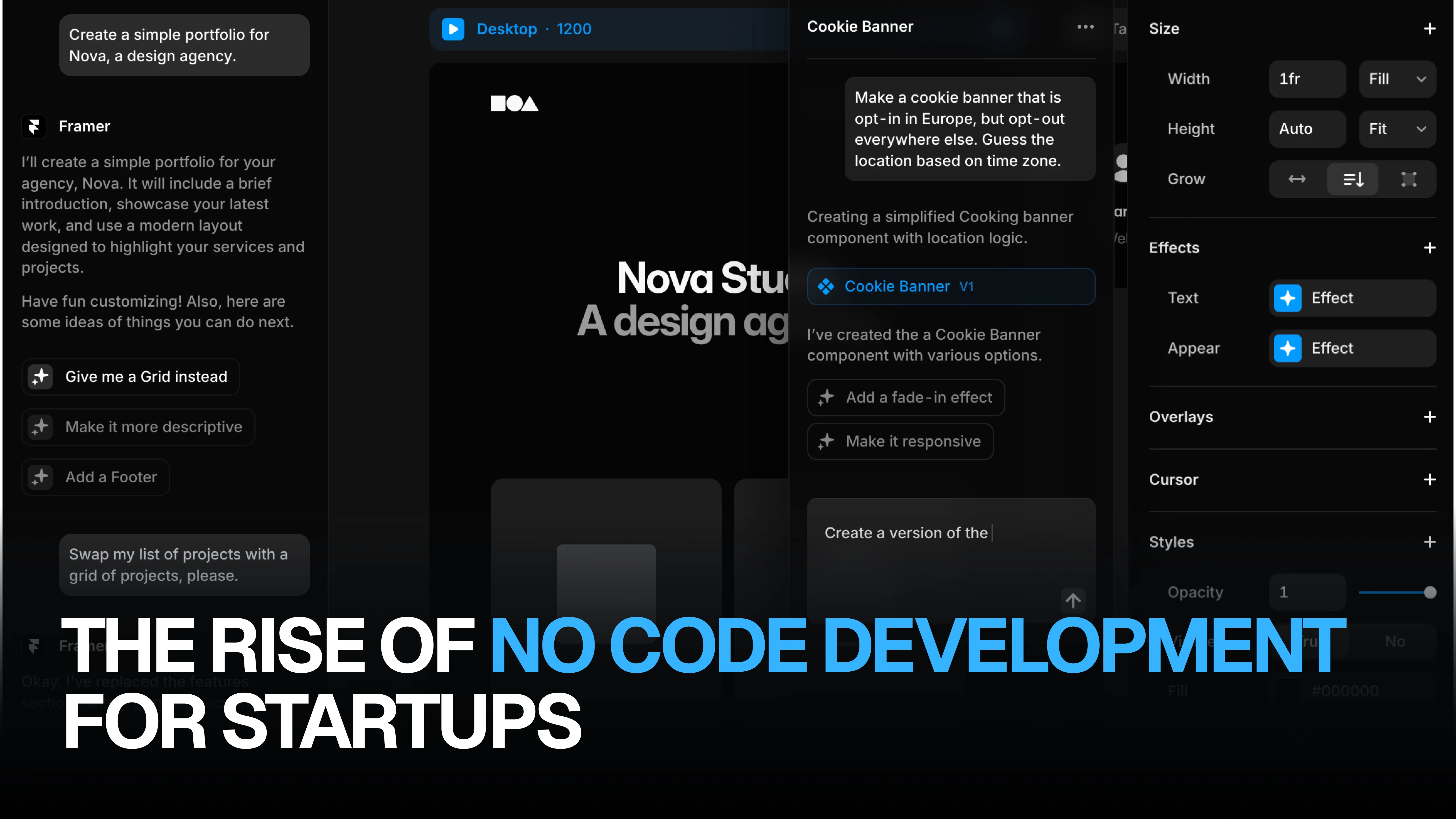
A technical breakdown of no-code architecture — how it works under the hood, when to use it, and how smart founders are shipping in weeks instead of months.
4 weeks – Avg. MVP timeline
$400/mo – vs $150K/year developer
70%+ – New apps via no/low-code
Somewhere along the way, “build fast” became synonymous with “hire engineers fast.” That assumption has quietly cost startups millions in runway, months in delays, and thousands in lost opportunity.
No-code breaks that equation — if you understand what it actually is.
What No-Code Actually Is — Technically
No-code is not “dumbed-down development.” It’s an abstraction layer — just like React abstracts the DOM, or SQL abstracts raw file handling.
When you drag a button into Webflow, the platform converts it into:
- Semantic HTML5
- Scoped CSS
- JavaScript interactions
This is production-level code — you’re not avoiding code, you’re delegating it to a visual compiler.
Example: Signup Flow (No-Code Logic)
TRIGGER: Button "Create Account" clicked

→ Validate email format, password strength
→ Hash password (bcrypt, server-side)
→ Write new User record to database
   role = "free_user"
   created_at = timestamp()
→ Trigger welcome email (SendGrid)
→ Set session cookie
→ Redirect to "/dashboard"
Zero manual coding. Full authentication system.
Webflow exports clean HTML/CSS.
Framer compiles to React.
These are not “locked systems” — they generate real code.
Why Founders Are Choosing No-Code
Speed of Validation
The biggest startup risk is building something nobody wants.
No-code reduces:
- Build time from months → days
- Testing cycle from weeks → hours
You can go from idea → live product in days.
Real Cost Comparison
Traditional Development
- $10,000+/month (1 developer)
- 3–6 months to MVP
- Slow iteration
- Low founder control
No-Code Stack
- $300–500/month
- 2–4 weeks MVP
- Fast iteration (hours)
- Full founder control
Founder Control (Underrated Advantage)
In traditional setups:
- You depend on developers for every change
With no-code:
- You control product updates directly
- Faster experimentation
- Faster growth decisions
The Actual No-Code SaaS Stack
A real product is built using multiple tools connected via APIs.
Example Stack:
- Marketing Site → Framer
- App Backend → Bubble
- Payments → Stripe
- Email → Loops
- Automation → Make
- Analytics → PostHog
- Support → Intercom
- File Storage → Uploadcare
Total Cost: ~$300–500/month
Time to MVP: 2–4 weeks
Developers Needed: 0
Platform Guide — What to Use
Bubble
Best for: Full SaaS apps
Includes: Database + backend
Verdict: Core product engine
Webflow
Best for: Marketing websites
Includes: CMS
Verdict: Best for SEO + content
Framer
Best for: Landing pages
Includes: React output
Verdict: Design-focused builds
Make / Zapier
Best for: Automation
Verdict: Connect everything
Retool
Best for: Internal tools
Verdict: Operations dashboards
For most startups:
Bubble (app) + Framer (marketing) is the ideal combo.
How to Build a No-Code MVP
Step 1: Define Data Model (Week 1)
- Users
- Products
- Transactions
Your database = your architecture.
Step 2: Build Workflows First (Week 1–2)
Focus on:
- Authentication
- Payments
- Core logic
UI comes later.
Step 3: Design UI (Week 2–3)
Keep it:
- Simple
- Functional
- Minimal
Avoid overdesigning early.
Step 4: Integrate Tools (Week 3)
- Stripe → payments
- Email tool → onboarding
- Analytics → tracking
Each takes under an hour.
Step 5: QA & Launch (Week 4)
- Test all user flows
- Fix edge cases
- Launch
Common Mistakes
- Building UI before database
- Using too many plugins
- Ignoring privacy rules
Limitations — The Honest Version
1. Performance Limits
Good for:
- Thousands of users
Not ideal for:
- Real-time systems
- Heavy computation
2. Vendor Lock-in
- Platforms are proprietary
- Migration requires rebuild
Solution:
- Export data regularly
- Use external APIs
3. Customization Limits
Not ideal for:
- Advanced animations
- Native mobile features
- Complex backend logic
Recommendation
Use no-code for:
- MVP
- Validation
- Early growth
Switch to hybrid when:
- $50K+ MRR
- 10K+ daily users
FAQ
Is no-code suitable for all startups?
No. Best for early-stage startups validating ideas.
Can no-code handle real users?
Yes. Many products scale to thousands of users and even $1M+ ARR.
Best no-code stack in 2025?
- Bubble
- Framer
- Stripe
- Loops
- Make
Do you build no-code products?
Yes. From landing pages to full SaaS platforms.



Accepted Payments


